Bonjour, mes amis! Welcome to the wonderfully weird world of French verbs, where conjugation can sometimes feel like trying to assemble IKEA furniture with chopsticks. But fear not! Today, we're tackling a seemingly simple yet surprisingly sassy verb: Prendre – to take. And specifically, we're diving headfirst into its present tense form. So grab your metaphorical croissants and let's prendre (see what I did there?) a look!
Le Présent: Why Bother?
Okay, okay, I know what you're thinking: "Why should I care about the present tense? Can't I just point and grunt my way through France?" Well, technically, yes. You could. But you'd be missing out on so much more. The present tense is the backbone of everyday conversation. It's how you say, "I take," "You take," "He/She/It takes," and, crucially, "We take all the pastries!" Understanding it is the key to unlocking a world of perfectly conjugated deliciousness.
Think of it this way: imagine trying to order coffee. You could mime drinking from a cup, but wouldn't it be easier (and less likely to result in you accidentally ordering a cat) to simply say, "Je prends un café"? Exactly! Le présent, it’s your friend.
Taking a Closer Look: Conjugation Time!
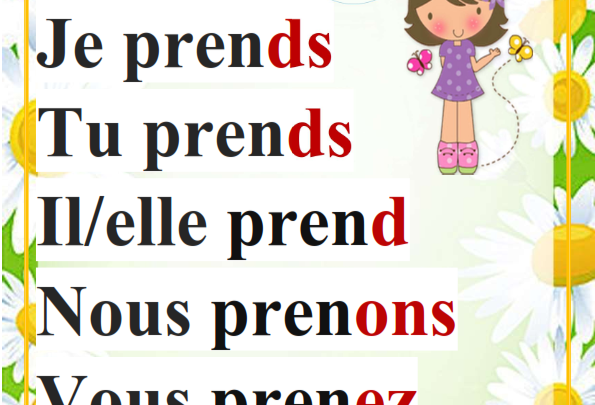
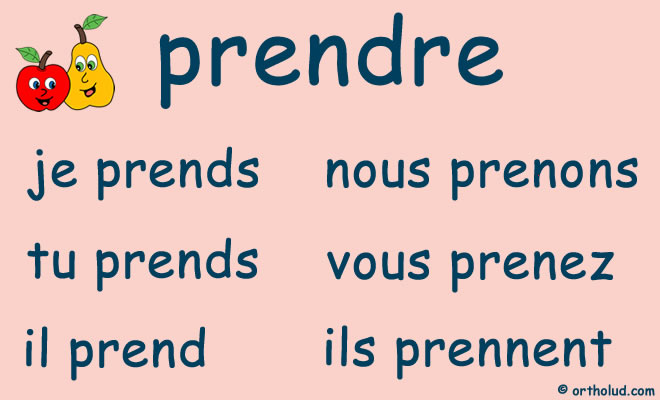
Alright, let's get down to brass tacks. Here's how Prendre shapes up in the present tense. Buckle up, it's a bit… quirky.
- Je prends - I take. (Or, more realistically, "I'm taking ALL the cheese.")
- Tu prends - You take. (Hopefully, you're taking notes.)
- Il/Elle/On prend - He/She/One takes. (On prend souvent du vin en France - One often takes wine in France. Wink, wink.)
- Nous prenons - We take. (We are taking this French lesson seriously... mostly.)
- Vous prenez - You take (formal/plural). (You all are taking a risk trying to pronounce these verbs correctly.)
- Ils/Elles prennent - They take. (They are taking advantage of the all-you-can-eat buffet.)
Notice anything... interesting? That sneaky "d" disappearing in the first three forms? Yeah, French verbs love to keep you on your toes. Don't worry, you'll get used to it. Or at least, you'll learn to blame the French for their linguistic shenanigans.
Pronunciation Pitfalls (and How to Avoid Them)
Okay, so you've memorized the conjugations. Great! Now comes the fun part: actually saying them. Here are a few pronunciation pointers to prevent you from sounding like a confused tourist (or at least, a less confused tourist):
- Je prends, Tu prends, Il/Elle/On prend: These all sound pretty much the same! It's a nasal "pron" sound. Think of clearing your throat while trying to say "prom." Charming, isn't it?
- Nous prenons: This one's a bit easier. "Pre-nohn." Make sure you pronounce that "n" at the end. It's important!
- Vous prenez: Similar to "nous prenons," but with a "z" sound instead of an "n" at the end. "Pre-nay."
- Ils/Elles prennent: Back to the nasal sound! "Pron." Again, identical to the first three forms. The French are just messing with you at this point.
The key is to practice, practice, practice! Say them out loud, even if you feel silly. The more you hear and say them, the more natural they'll become. And remember, even if you mess up, the French are usually pretty forgiving (especially if you're offering them cheese).
Beyond "I Take": Using Prendre in Context
Now that you've mastered the conjugations, let's see how Prendre is actually used in real-life situations. It's not just about physically taking things; it has a whole range of meanings.

Taking Things (Literally)
This is the most straightforward meaning. You're physically taking something into your possession.
- Je prends le livre. - I take the book. (Hopefully, it's a good one!)
- Tu prends le bus? - Are you taking the bus? (Or are you feeling adventurous and hitchhiking?)
- Il prend le gâteau. - He takes the cake. (And probably eats it too!)
Taking Food and Drink
This is a big one, especially in France, where food is practically a religion. Prendre is often used to talk about ordering or consuming food and drink.
- Je prends un café, s'il vous plaît. - I'll have a coffee, please. (The most important phrase you'll learn in France.)
- Elle prend une salade. - She's having a salad. (Good for her. I'm having the croissant.)
- Nous prenons le petit déjeuner à 8 heures. - We have breakfast at 8 o'clock.
Taking Transportation
As you saw earlier, Prendre is also used to talk about taking various forms of transportation.
- Vous prenez le train pour Paris? - Are you taking the train to Paris? (Lucky you!)
- Ils prennent l'avion demain. - They're taking the plane tomorrow. (Hopefully, they packed their phrasebook.)
- Je prends le métro. - I'm taking the subway. (Watch out for pickpockets!)
Taking Time and Opportunities
Prendre can also be used in more abstract ways, such as taking time or seizing opportunities.
- Je prends mon temps. - I'm taking my time. (Good advice, especially when enjoying a glass of wine.)
- Il prend une douche. - He's taking a shower. (Hopefully, he's using soap.)
- Elle prend des risques. - She takes risks. (Living on the edge!)
Idiomatic Expressions with Prendre
And of course, no French verb lesson would be complete without a few idiomatic expressions. These are phrases where Prendre has a meaning that's not immediately obvious from the literal translation.
- Prendre froid - To catch a cold. (Literally, "to take cold.") J'ai pris froid hier. - I caught a cold yesterday.
- Prendre son mal en patience - To bear one's suffering patiently. (Literally, "to take one's pain in patience.") Il faut prendre son mal en patience. - One must bear one's suffering patiently. (Easier said than done!)
- Prendre son courage à deux mains - To pluck up one's courage. (Literally, "to take one's courage with two hands.") J'ai pris mon courage à deux mains et j'ai parlé au professeur. - I plucked up my courage and spoke to the professor.
- Se prendre pour quelqu'un - To think oneself important. (Literally, "to take oneself for someone.") Il se prend pour quelqu'un! - He thinks he's someone special! (Usually said with a healthy dose of sarcasm.)
- Prendre la mouche - To get offended easily. (Literally, "to take the fly.") Il prend la mouche pour un rien. - He gets offended over nothing.
These are just a few examples, and there are many more. The best way to learn them is to encounter them in context, so keep reading and listening to French!
Common Mistakes (and How to Avoid Looking Like a Fool)
Alright, let's address some common pitfalls that even seasoned French learners sometimes stumble upon.
- Forgetting the "d" disappearance: It's easy to accidentally say "Je prends" like "Je prend," but remember, the "d" vanishes in the je, tu, il/elle/on forms. Practice makes perfect!
- Confusing "Prendre" with "Boire": While both verbs can be used with food and drink, Prendre is generally used for ordering or having something, while Boire (to drink) is used for the actual act of drinking. So you prends un café, and then you bois le café.
- Overusing "Prendre": While Prendre is a versatile verb, don't be afraid to use other verbs when appropriate. For example, instead of saying "Je prends une photo," you could say "Je fais une photo" (I take/make a photo).
- Ignoring the idiomatic expressions: These can be tricky, but they add a lot of flavor to your French. Don't be afraid to look them up and use them! Just be careful to use them correctly, or you might end up saying something unintentionally hilarious.
Practice Makes Perfect (and Prevents Embarrassing Mistakes)
Okay, enough theory! Let's put your newfound knowledge to the test. Here are a few exercises to help you solidify your understanding of Prendre in the present tense:
Exercise 1: Fill in the Blanks
Fill in the blanks with the correct form of Prendre:
- Je ______ un croissant et un café. (I'm having a croissant and a coffee.)
- Tu ______ le bus pour aller au travail? (Do you take the bus to go to work?)
- Il ______ toujours son temps. (He always takes his time.)
- Nous ______ des photos de la Tour Eiffel. (We're taking photos of the Eiffel Tower.)
- Vous ______ le train de 10 heures? (Are you taking the 10 o'clock train?)
- Elles ______ toujours des risques. (They always take risks.)
Exercise 2: Translate the Sentences
Translate the following sentences into French, using Prendre in the present tense:

- I take the book.
- She's having lunch.
- We're taking a walk.
- You (formal) are taking the subway.
- They are taking a vacation.
Exercise 3: Create Your Own Sentences
Write five original sentences using Prendre in the present tense. Be creative and have fun!
(Answers to the exercises are provided at the end of this article. No peeking!)
Beyond the Basics: Advanced Prendre-ology
For those of you who are feeling particularly ambitious, let's delve into some more advanced aspects of Prendre.
Prendre with Reflexive Pronouns
Prendre can also be used with reflexive pronouns to express actions that you do to yourself.
- Se prendre - To get caught, to be mistaken.
- Il s'est pris les pieds dans le tapis. - He tripped on the carpet. (Literally, "He took his feet in the carpet.")
- Je me suis pris pour un expert. - I mistook myself for an expert.
Prendre Participe Passé: Pris
The past participle of Prendre is Pris. This is used to form compound tenses like the passé composé.

- J'ai pris le train. - I took the train.
- Elle a pris une douche. - She took a shower.
The Subjunctive Mood (Because Why Not?)
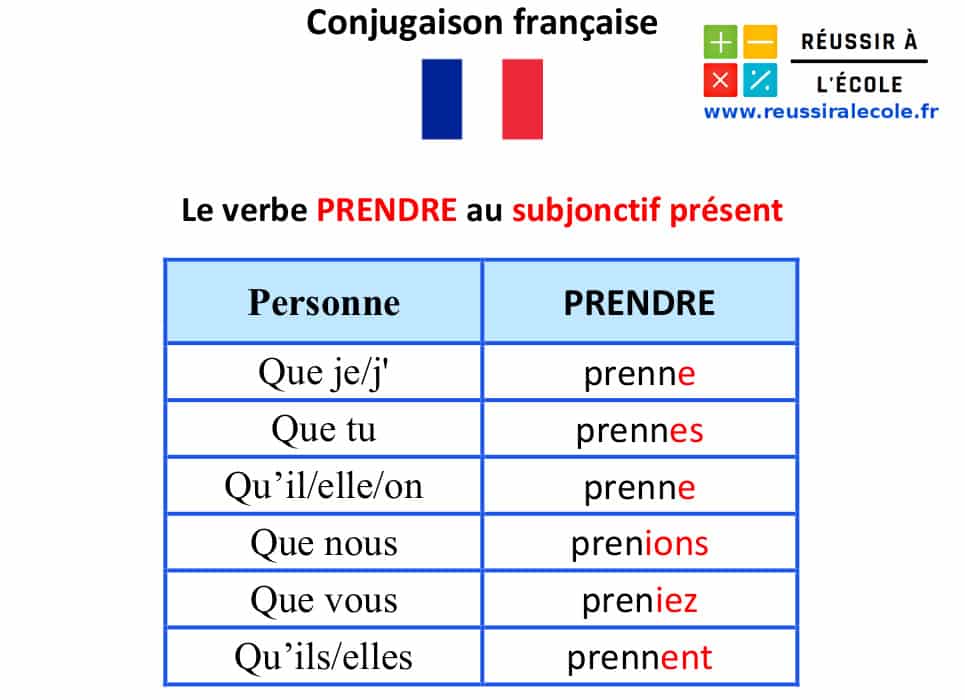
Just kidding! We're not going to torture you with the subjunctive mood today. But just know that Prendre can be conjugated in the subjunctive, and it's used in certain situations to express doubt, uncertainty, or emotion. But we'll save that for another day (and another bottle of wine).
Why Mastering Prendre Matters (Besides Impressing Your French Teacher)
So, why bother putting in the effort to learn all this stuff about Prendre? Here's why:
- You'll be able to communicate more effectively: The more comfortable you are with verbs like Prendre, the easier it will be to express yourself in French.
- You'll understand native speakers better: You'll be able to follow conversations more easily and understand the nuances of what people are saying.
- You'll sound more fluent: Using verbs correctly is a key component of sounding like a natural speaker.
- You'll unlock a deeper appreciation for the French language: Understanding the complexities of French grammar can actually be quite rewarding. (Okay, maybe not rewarding, but at least mildly interesting.)
- You'll be able to order food and drinks without embarrassing yourself: And let's be honest, that's the most important reason of all.
Ultimately, learning French verbs like Prendre is like building a house. Each verb is a brick, and the more bricks you have, the stronger your house (and your French skills) will be. So keep practicing, keep learning, and keep enjoying the journey!
Answers to the Exercises
Exercise 1: Fill in the Blanks
- Je prends un croissant et un café.
- Tu prends le bus pour aller au travail?
- Il prend toujours son temps.
- Nous prenons des photos de la Tour Eiffel.
- Vous prenez le train de 10 heures?
- Elles prennent toujours des risques.
Exercise 2: Translate the Sentences
- Je prends le livre.
- Elle prend le déjeuner.
- Nous prenons une promenade. (or: Nous faisons une promenade.)
- Vous prenez le métro.
- Ils prennent des vacances.
Conclusion: And Now, You Take the Cake!
Congratulations! You've successfully navigated the treacherous waters of Prendre in the present tense. You've conjugated, you've pronounced, you've even learned some idiomatic expressions. You deserve a medal… or at least a pain au chocolat. So go forth, my friend, and prends the French language by the horns! Just don't prendre anything that doesn't belong to you. Unless it's a compliment. You should definitely prendre those.
Now, if you'll excuse me, I'm going to go prendre a nap. All this French has made me sleepy. À bientôt!