Salut mes amis! Let's talk about something near and dear to every French learner's heart (or perhaps near and dreaded): être and avoir in the present tense. Yes, those verbs. The foundation upon which so much of the French language is built. They're like the peanut butter and jelly of French grammar – seemingly simple, but surprisingly complex and, let's be honest, occasionally sticky. We'll explore them with a playful lens, complete with witty remarks and the occasional "wink" to keep things light and entertaining. Prepare to laugh, learn, and maybe even accidentally conjugate correctly. C’est parti!
The Dynamic Duo: Être (To Be) and Avoir (To Have)
First, let's acknowledge the elephant in the room: these verbs are EVERYWHERE. Seriously, they're like that friend who always shows up uninvited, but you secretly like having around because they're hilarious. They're fundamental, they're indispensable, and they’re the key to unlocking a whole world of French verb conjugation. Think of them as the VIP passes to the exclusive club of French grammar. Without them, you're stuck outside, peering through the window at all the fun.
Être: The Verb of Existence (and Being Dramatic)
Être, meaning "to be," is your go-to verb for describing who you are, what you are, and where you are (figuratively and literally). It's the verb of identity, of essence, of existential crises. But mostly, it's just a verb. A very important verb.
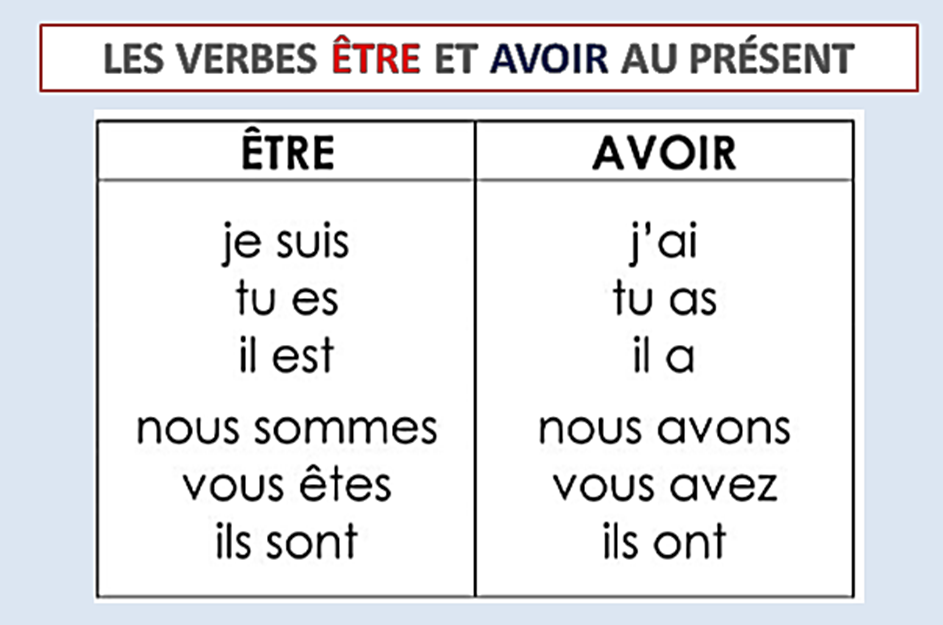
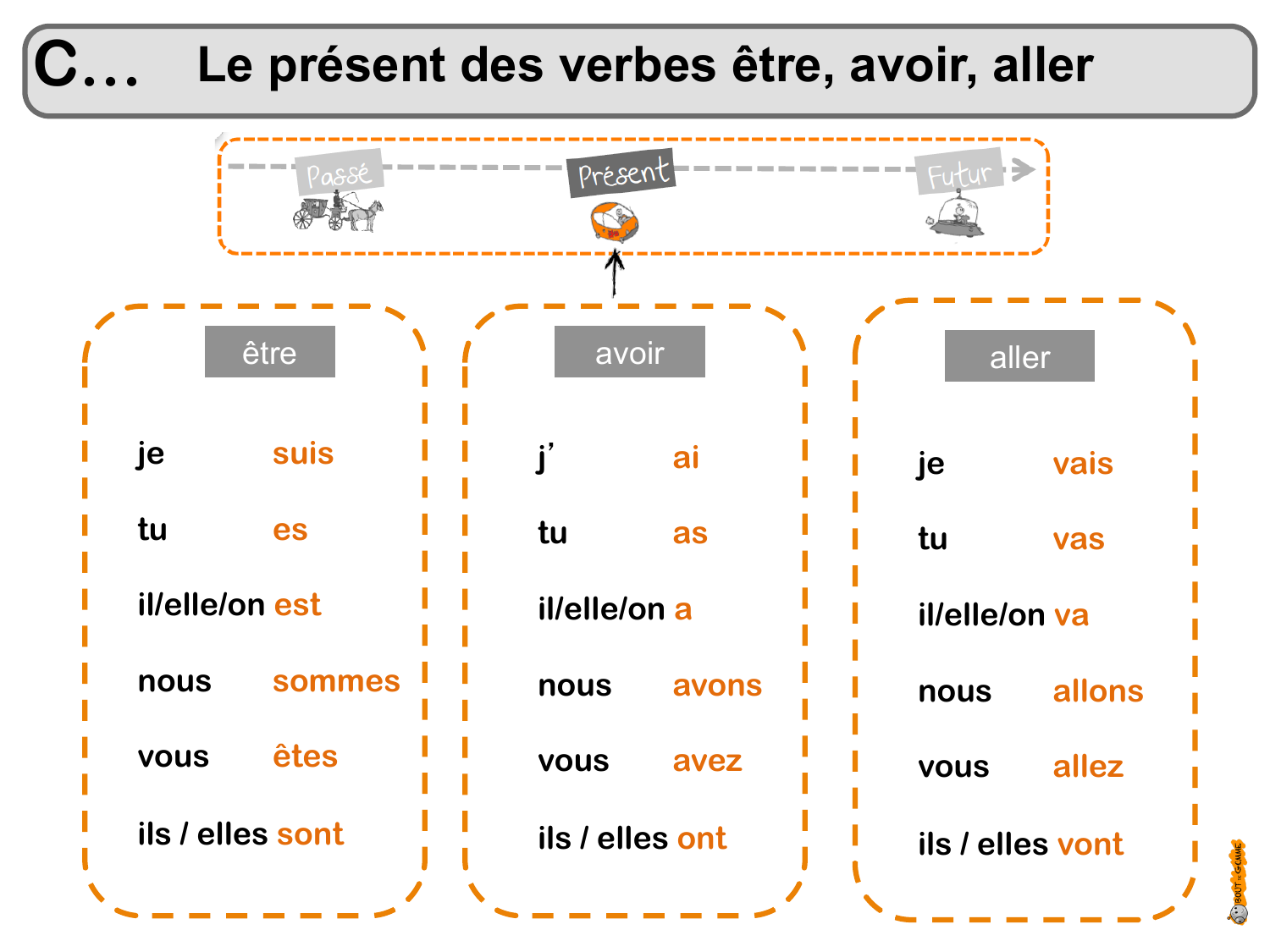
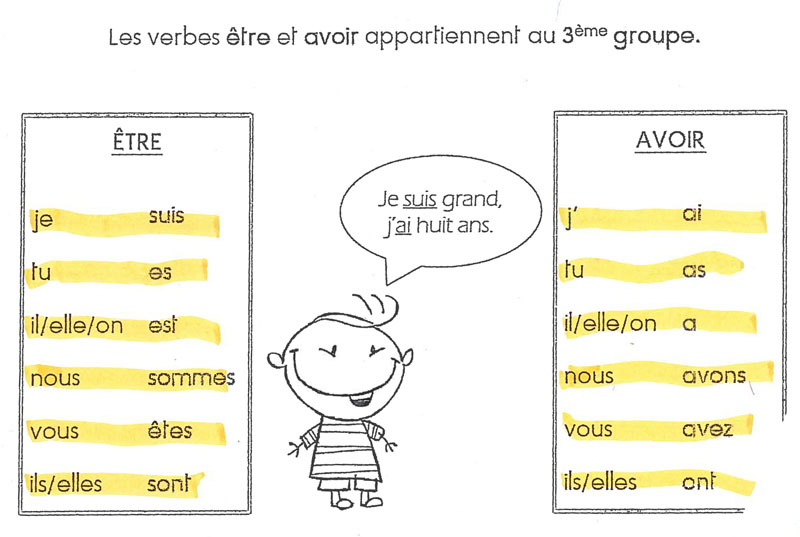
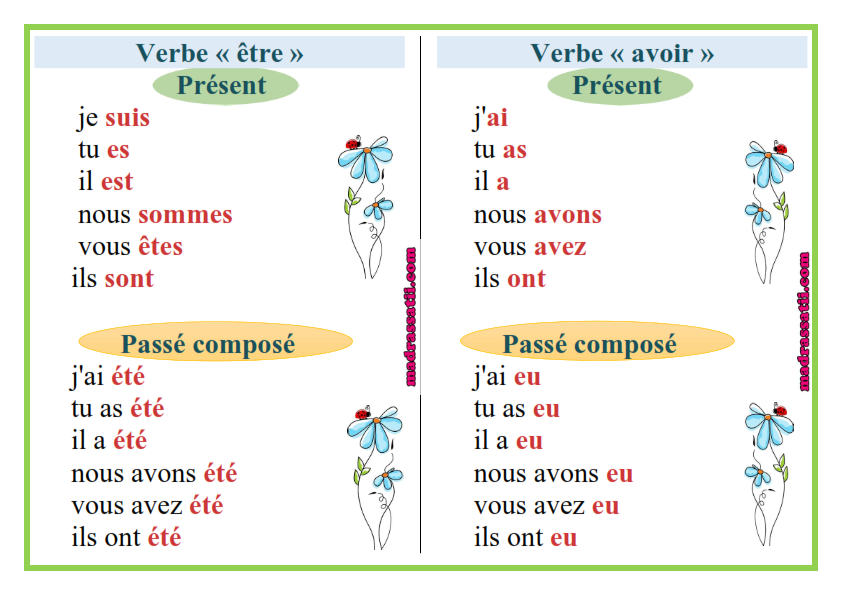
Here's how it conjugates in the present tense:
- Je suis (I am) - Je suis fatigué après avoir essayé de conjuguer ces verbes! (I am tired after trying to conjugate these verbs!)
- Tu es (You are) - Tu es incroyable! (You are incredible! ... for attempting to learn French.)
- Il/Elle/On est (He/She/One is) - Il est français. Elle est charmante. On est d'accord que ces verbes sont importants. (He is French. She is charming. We agree that these verbs are important.) Note that "on" can mean "one," "we," or "they" in informal settings, so be careful!
- Nous sommes (We are) - Nous sommes tous dans le même bateau! (We are all in the same boat! ... the boat of struggling with French grammar.)
- Vous êtes (You are) - (Formal or plural) Vous êtes formidables! (You are wonderful!)
- Ils/Elles sont (They are) - Ils sont motivés. Elles sont prêtes à apprendre! (They are motivated. They are ready to learn!)
Notice the slightly irregular forms? "Je suis" and "Tu es" stand out, don't they? Don't worry, you'll get used to them. Just keep chanting them like a mantra. Je suis, tu es, il est… Repeat until enlightenment is achieved (or until your brain melts, whichever comes first).
Uses of Être:
- To describe identity and characteristics: Je suis étudiant. Elle est grande. (I am a student. She is tall.)
- To express nationality and origin: Il est américain. Nous sommes canadiens. (He is American. We are Canadian.)
- To indicate professions: Vous êtes médecin. Ils sont professeurs. (You are a doctor. They are teachers.)
- To describe states of being: Je suis content. Tu es triste. (I am happy. You are sad.)
- To form the passé composé (past tense) with certain verbs: Je suis allé au cinéma. Elle est venue me voir. (I went to the cinema. She came to see me.) This is where things get REALLY interesting (and potentially confusing). We'll touch on this later, but for now, just know that "être" is a team player in the past tense game.
- Location: Nous sommes à Paris. (We are in Paris.)
A little "être" humor: Why did the verb "être" break up with the noun? Because it said, "I can't be with you anymore!" (I know, I know, I'll show myself out.)

Avoir: The Verb of Possession (and Sometimes Obligations)
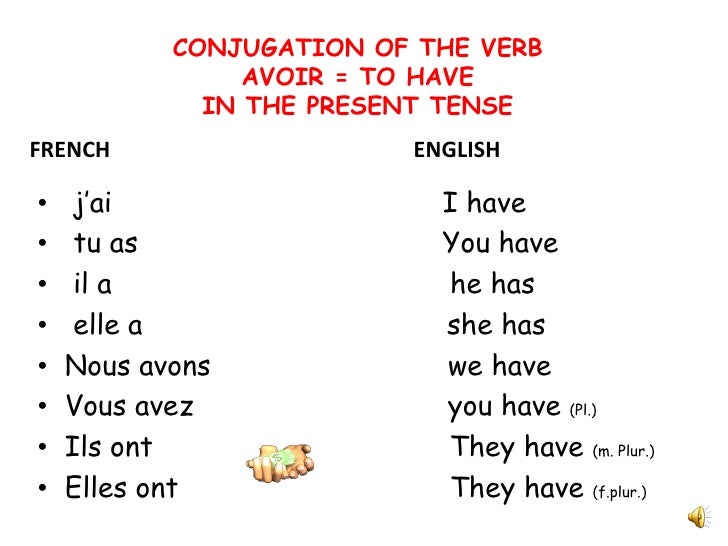
Avoir, meaning "to have," is all about possession, age, and sometimes, surprisingly, obligations. It's the verb you use to declare ownership of that croissant, that new car, or that overwhelming sense of despair after realizing how much French grammar there is to learn (just kidding... mostly!).
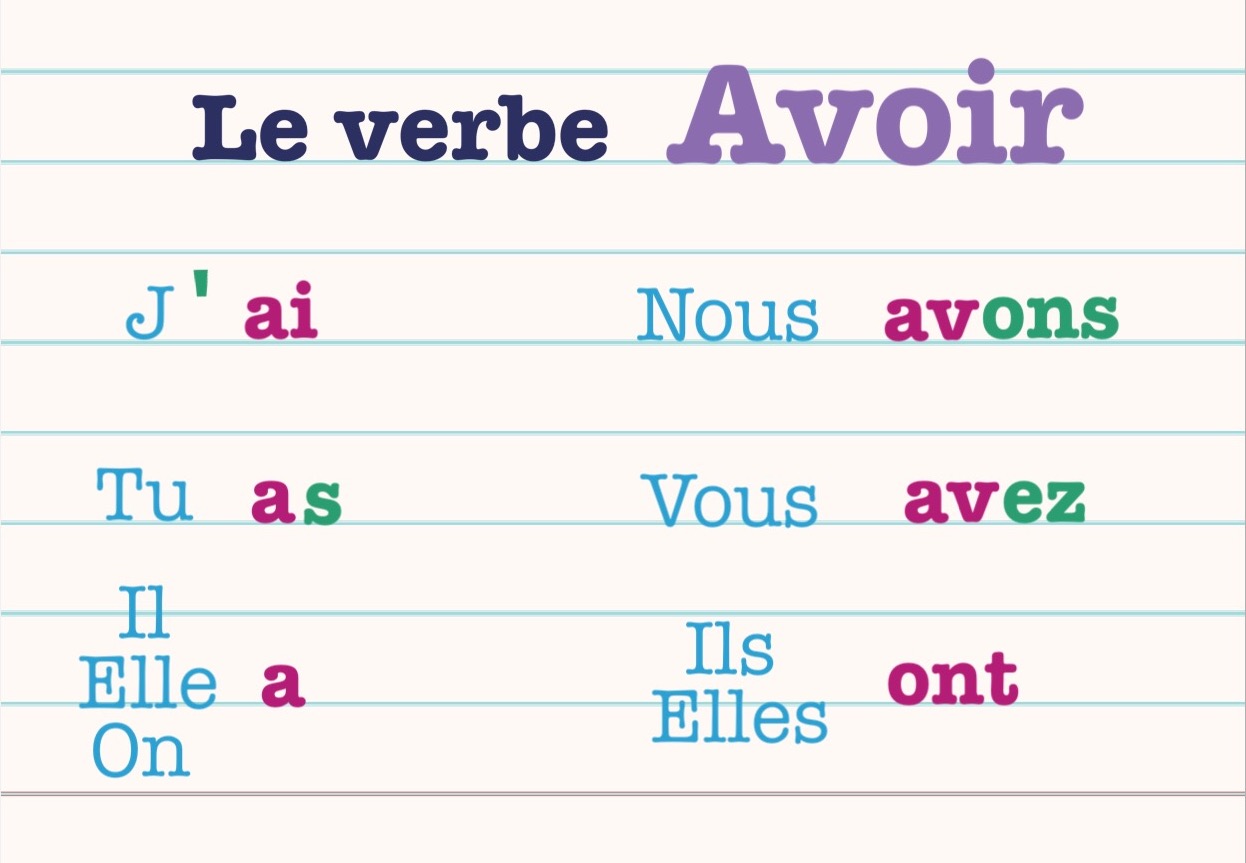
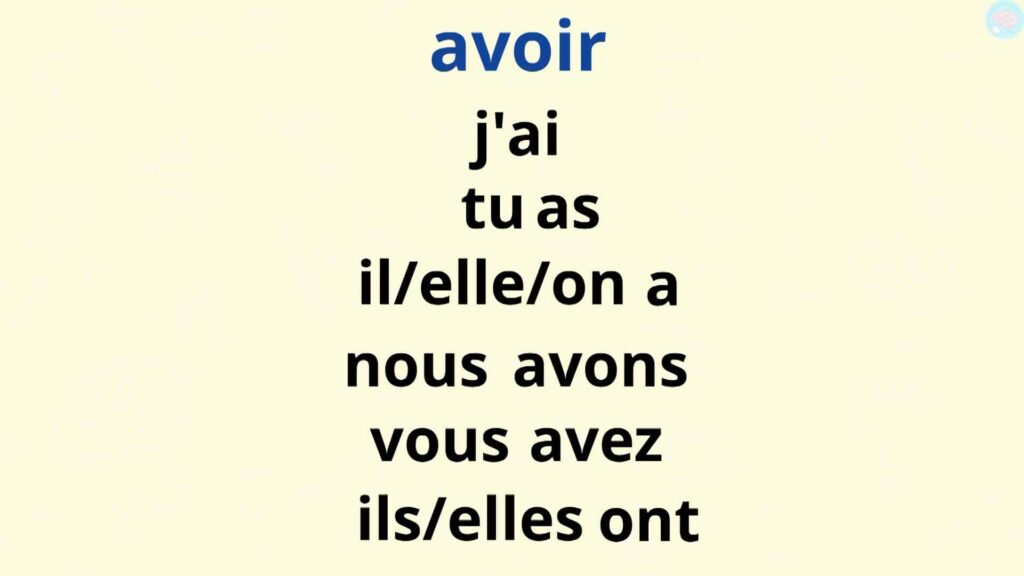
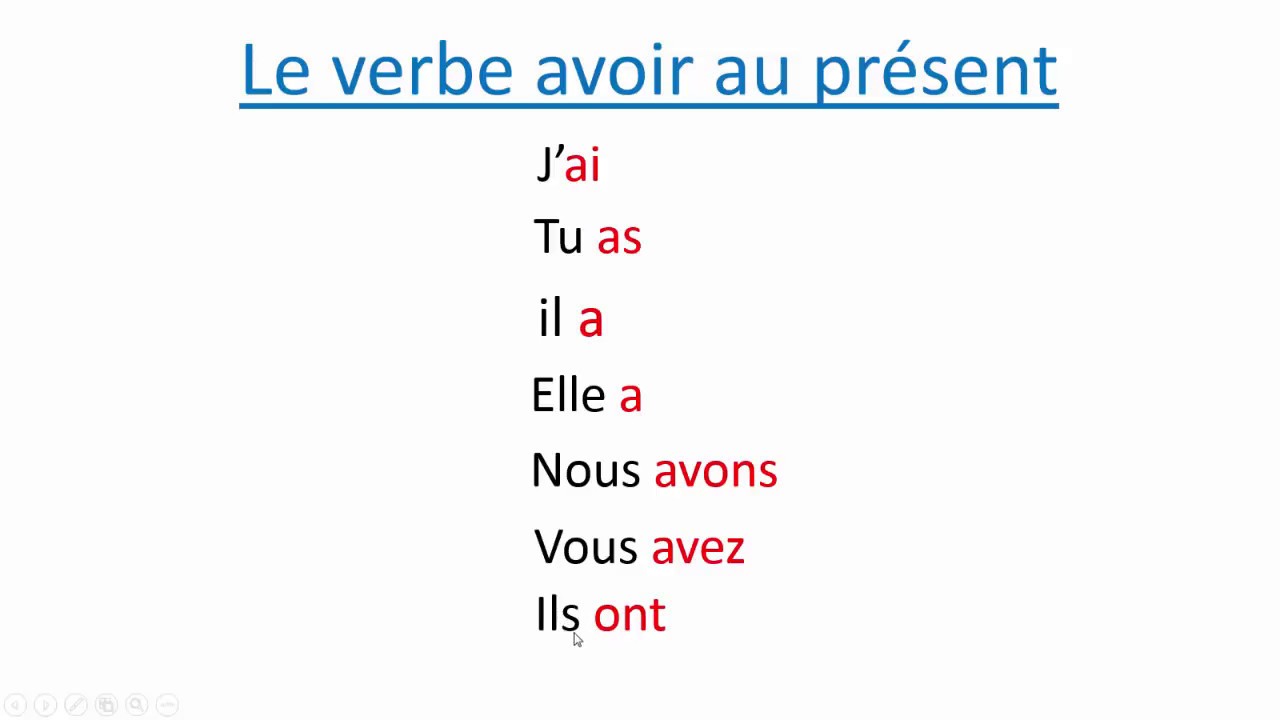
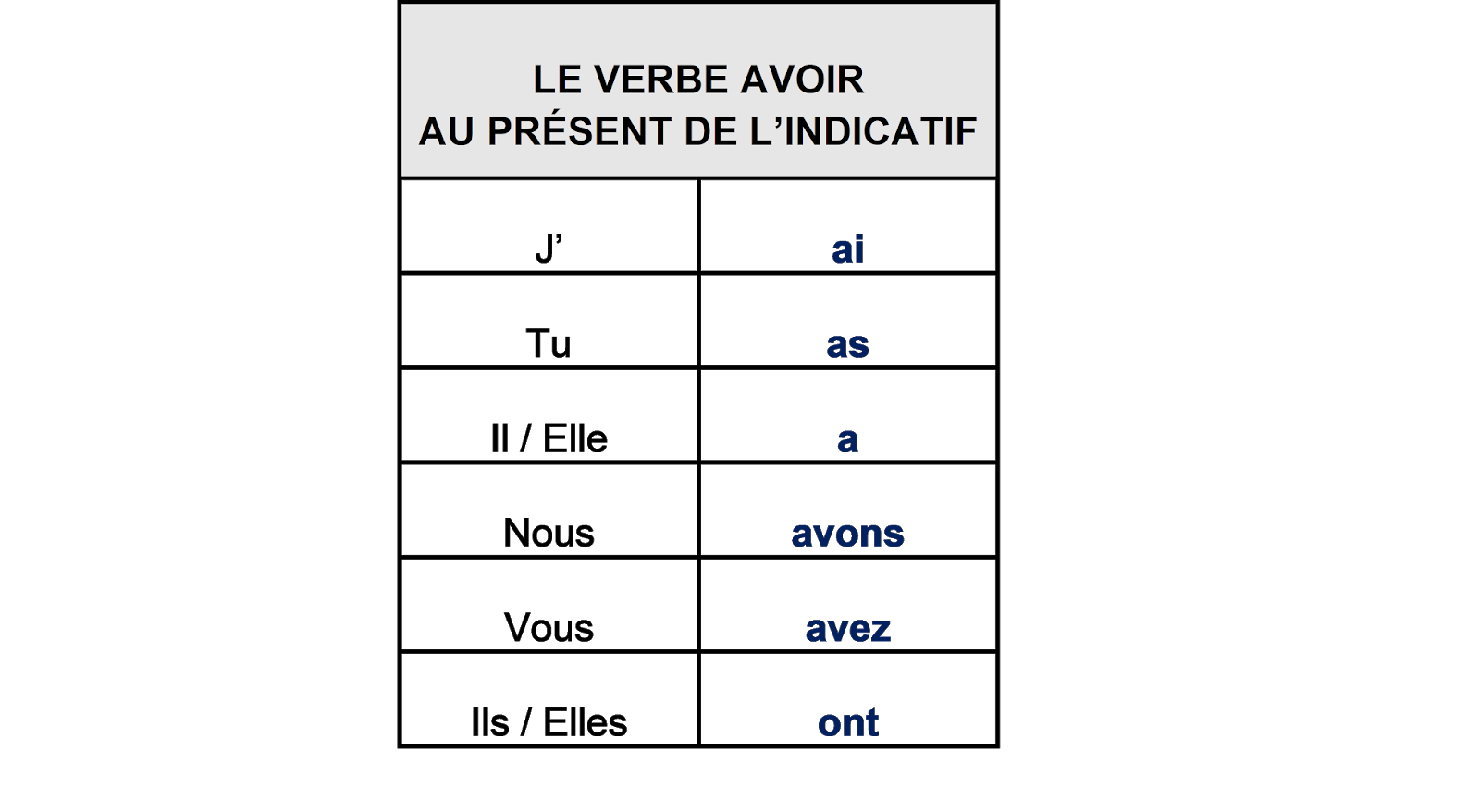
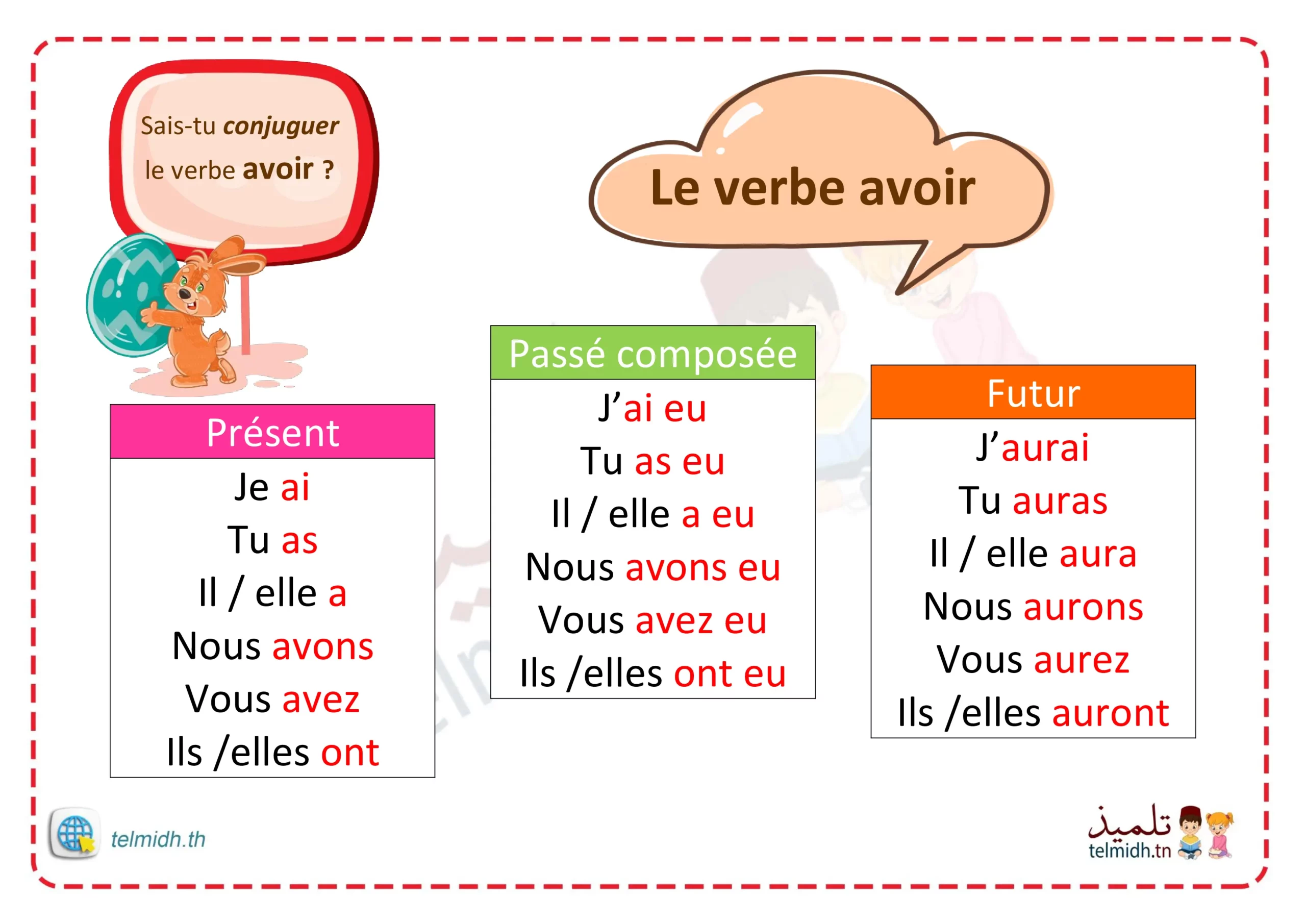
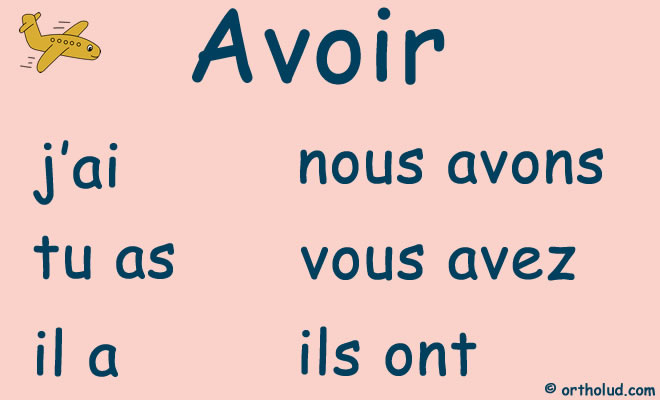
Here's how "avoir" rolls in the present tense:
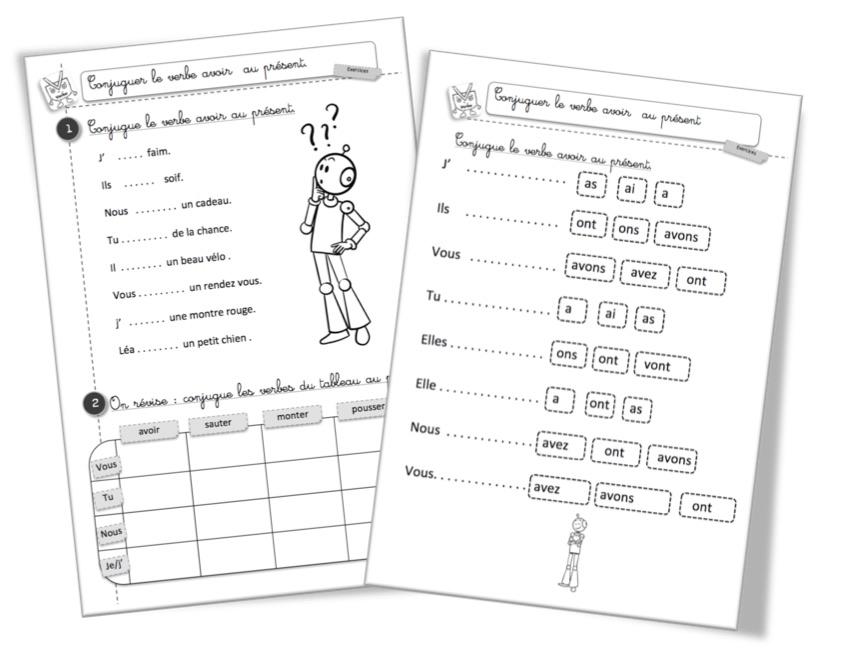
- J'ai (I have) - J'ai un chat. (I have a cat.) Notice the elision (J' + ai becomes J'). French loves to smoosh words together to sound fancier.
- Tu as (You have) - Tu as de la chance! (You are lucky!)
- Il/Elle/On a (He/She/One has) - Il a une voiture. Elle a faim. On a du pain. (He has a car. She is hungry. We have bread.)
- Nous avons (We have) - Nous avons beaucoup de travail. (We have a lot of work.)
- Vous avez (You have) - (Formal or plural) Vous avez raison! (You are right!)
- Ils/Elles ont (They have) - Ils ont soif. Elles ont un nouveau livre. (They are thirsty. They have a new book.)
Again, we see some irregularities! "J'ai" is the star here, with its apostrophe-tastic makeover. And keep an eye on the pronunciation, especially with "ils ont" and "elles ont" - the "ont" is pronounced almost like the "on" in "bon."
Uses of Avoir:
- To express possession: J'ai un livre. Nous avons une maison. (I have a book. We have a house.) Pretty straightforward, right?
- To express age: J'ai trente ans. Elle a vingt ans. (I am thirty years old. She is twenty years old.) In French, you "have" your age, you don't "be" it. So, technically, you possess the burden of your years. Charming.
- To express physical sensations: J'ai faim. Il a soif. Nous avons chaud. (I am hungry. He is thirsty. We are hot.) Again, you "have" hunger, thirst, and heat. French logic, folks.
- To express obligations with "avoir à + infinitive": Je dois étudier. Nous devons partir. (I have to study. We have to leave.) This is where "avoir" takes on a slightly different role, becoming a helping verb to express necessity. Think of it as "having" the obligation to do something.
- To form the passé composé (past tense) with most verbs: J'ai mangé. Elle a vu. (I ate. She saw.) This is "avoir's" bread and butter (or perhaps, croissant and butter?). It's the go-to auxiliary verb for forming the past tense of the majority of French verbs.
A little "avoir" humor: What did the French verb "avoir" say to the English verb "to have"? "You're having a good time? I'm always having to help everyone!" (Still not funny? Okay, moving on.)
Être vs. Avoir: A Head-to-Head Showdown (Kind Of)
Now that we've introduced our contenders, let's delve into the nuances of when to use "être" and when to use "avoir." This is where the fun really begins (or the frustration, depending on your perspective).
The General Rule:
- Use être for describing being, identity, characteristics, and states of being. Think about things that are inherent or relatively permanent.
- Use avoir for expressing possession, age, and obligations (with "avoir à + infinitive"). Think about things that you possess or experience.
However, as with most things in French, there are exceptions:
- Physical sensations: Remember, in French, you have hunger, thirst, heat, cold, fear, etc. It's not about "being" hungry; it's about "having" the sensation of hunger. J'ai faim, j'ai soif, j'ai peur.
- Expressions with "avoir": There are many idiomatic expressions in French that use "avoir," even when they might seem to describe a state of being. For example: avoir raison (to be right), avoir tort (to be wrong), avoir de la chance (to be lucky). You don't be right; you have rightness! (Or something like that.)
The Passé Composé Complication:
As mentioned earlier, both "être" and "avoir" play a crucial role in forming the passé composé, which is a common past tense in French. Most verbs use "avoir" as the auxiliary verb, but a select group of verbs (mostly verbs of motion and reflexive verbs) use "être."
Verbs that use "être" in the passé composé often fall into the "DR & MRS VANDERTRAMP" category:
- Devenir (to become)
- Revenir (to come back)
- Monter (to go up)
- Rester (to stay)
- Sortir (to go out)
- Venir (to come)
- Aller (to go)
- Naître (to be born)
- Descendre (to go down)
- Entrer (to enter)
- Rentrer (to re-enter)
- Tomber (to fall)
- Retourner (to return)
- Arriver (to arrive)
- Mourir (to die)
- Partir (to leave)
Memorizing this list (or at least becoming familiar with it) is essential for mastering the passé composé. And remember, with verbs that use "être" in the passé composé, the past participle must agree in gender and number with the subject. So, if a woman says "Je suis allée," she adds an "e" to the end of "allé" to indicate that she is female.
Confused yet? Don't worry, everyone is at first. The key is practice, practice, practice. And maybe a large glass of wine. (For "research purposes," of course.)
Tips and Tricks for Mastering Être and Avoir
Okay, so you're armed with the basics. Now, let's equip you with some handy tips and tricks to help you conquer "être" and "avoir" like a pro:
- Flashcards: Old-school, but effective. Write the conjugations on one side and the pronoun on the other. Quiz yourself regularly.
- Online Quizzes and Exercises: There are tons of free resources online that offer interactive exercises to test your knowledge.
- Immersion: Surround yourself with French as much as possible. Watch French movies and TV shows, listen to French music, read French books and articles. The more you're exposed to the language, the more natural the usage of "être" and "avoir" will become.
- Practice with a Language Partner: Find a native French speaker or another French learner to practice with. This is a great way to get feedback on your pronunciation and grammar.
- Don't Be Afraid to Make Mistakes: Everyone makes mistakes when learning a new language. It's part of the process. The important thing is to learn from your mistakes and keep practicing.
- Use Mnemonics: Create memorable phrases or acronyms to help you remember the conjugations and uses of "être" and "avoir." For example, you could use "SAME" (State, Age, Nationality, Emotion) to remember some of the common uses of "être."
- Focus on Context: Pay attention to the context in which "être" and "avoir" are used. This will help you understand the meaning and choose the correct verb.
- Break It Down: Don't try to learn everything at once. Focus on mastering one conjugation or use at a time.
- Be Patient: Learning a new language takes time and effort. Don't get discouraged if you don't see results immediately. Just keep practicing and you'll eventually get there.
- Find the Fun: Learning a language should be enjoyable! Find ways to make the process fun and engaging. Watch French comedies, listen to upbeat French music, or cook French recipes.
Common Mistakes to Avoid (and Laugh About)
Let's face it, we all make mistakes. It's part of being human (and especially part of being a language learner). Here are some common mistakes to watch out for (and maybe have a chuckle at):

- Using "être" instead of "avoir" for age: Remember, you have your age in French, you don't be it. So, it's "J'ai trente ans," not "Je suis trente ans." Saying "Je suis trente ans" would be like saying "I am thirty years," which just sounds... strange.
- Forgetting the elision with "j'ai": Always remember to contract "je" to "j'" before "ai." "J'ai" is correct; "Je ai" is not. It's a simple rule, but easy to forget in the heat of the moment.
- Incorrect agreement of past participles with "être": When using "être" in the passé composé, remember to make the past participle agree in gender and number with the subject. This is a classic mistake, even for advanced learners.
- Confusing "avoir besoin de" with "être besoin de": "Avoir besoin de" means "to need." "Être besoin de" is incorrect. Always use "avoir" when expressing need.
- Overthinking it: Sometimes, the best thing to do is just relax and go with your gut. Overthinking can lead to paralysis and even more mistakes. Trust your instincts (after you've studied, of course!).
A Mistake Story (for Your Amusement):
Once, a friend of mine, while trying to impress a French waiter, confidently declared, "Je suis chaud!" intending to say "I am hot" in the sense of being physically warm. However, in French, "Je suis chaud" can also mean "I am horny." The waiter's reaction was... priceless. The moral of the story? Double-check your vocabulary before using it in public!
Être and Avoir: Beyond the Basics (A Glimpse into the Future)
So, you've mastered "être" and "avoir" in the present tense. Congratulations! You've taken a giant leap towards French fluency. But the journey doesn't end here. There's still so much more to explore! Here's a sneak peek at what awaits you:
- The Imperfect Tense: Learn how to describe habitual actions and states of being in the past using the imparfait. "Être" and "avoir" have their own imparfait forms, of course!
- The Future Tense: Discover how to express future actions and intentions using the futur simple. "Être" and "avoir" also have their own futur simple forms.
- The Conditional Tense: Explore the world of "what ifs" and hypothetical situations using the conditionnel. You guessed it, "être" and "avoir" are involved!
- The Subjunctive Mood: Delve into the realm of subjectivity, doubt, and emotion using the subjonctif. "Être" and "avoir" have their own subjunctive forms, which are often irregular and, let's be honest, a bit intimidating.
- Compound Tenses: Master the art of combining auxiliary verbs (like "être" and "avoir") with past participles to form complex past tenses.
- Idiomatic Expressions: Continue to expand your vocabulary of idiomatic expressions that use "être" and "avoir."
The world of French grammar is vast and complex, but it's also incredibly rewarding. The more you learn, the more you'll appreciate the beauty and nuance of the language. And remember, "être" and "avoir" will be your faithful companions every step of the way.
Conclusion: You've Got This (Probably)!
So, there you have it! A (hopefully) humorous and informative look at the wonderful world of "être" and "avoir" in the present tense. You've laughed, you've learned, and you've probably developed a newfound appreciation (or maybe just a mild tolerance) for these essential French verbs. Remember, practice makes perfect (or at least, practice makes you less likely to accidentally tell a waiter you're horny). So, keep conjugating, keep practicing, and keep embracing the quirks and complexities of the French language. You've got this (probably)! And if not, well, at least you can say "Je suis fatigué(e)" with confidence. And isn't that what really matters?