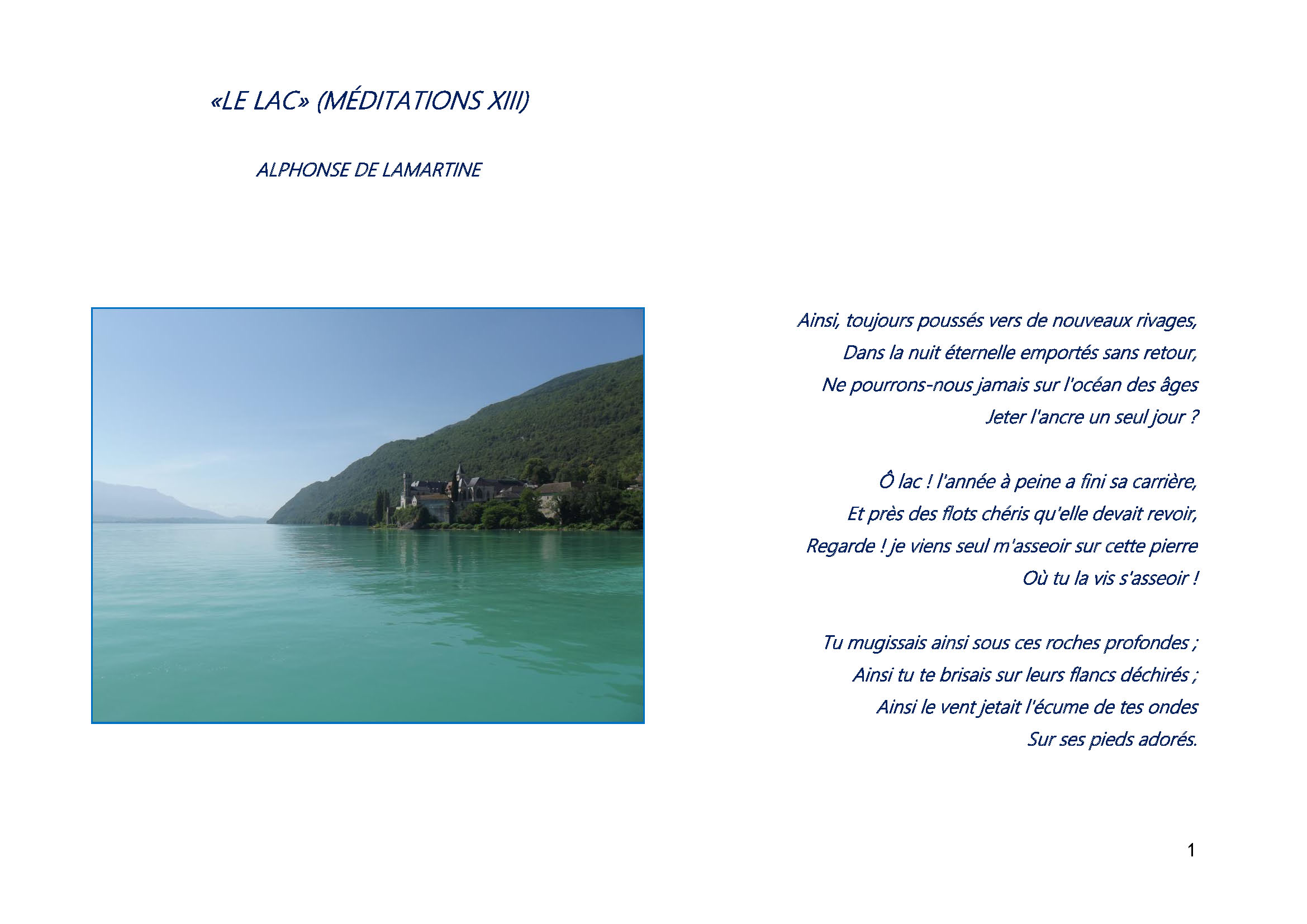
Ah, Le Lac de Lamartine! Just the name conjures up images of dramatic sunsets, weeping willows, and enough romantic angst to power a small city. If you're anything like me, you probably first encountered this poem in a high school French class, where it was presented with the solemnity usually reserved for declaring war or opening a particularly difficult jar of pickles. Mais, laissez-moi vous dire, behind all the serious literary analysis lies a surprisingly… well, let's just say interesting read.
Why Le Lac Still Matters (Even if You Think Poetry is Just Fancy Word Salad)
Okay, okay, before you click away to watch cat videos (and honestly, who could blame you?), hear me out. Le Lac isn't just some dusty old poem that your grandmother forced you to memorize. It's a window into a specific moment in literary history, a perfect example of Romanticism in full bloom. Think of it as the 19th-century equivalent of a particularly dramatic Instagram post, complete with filters, captions dripping with emotion, and a questionable understanding of reality.
But beyond the historical significance, there are actually some genuinely compelling reasons to give Le Lac a second look:
- It's a Masterclass in Melodrama: Lamartine doesn't just feel emotions; he wrestles with them. He doesn't just miss his lover; he questions the very fabric of existence! It's over-the-top, sure, but undeniably captivating in its intensity. Think of it as the operatic version of a breakup.
- It Explores Timeless Themes: Loss, memory, the fleeting nature of time… these are things we all grapple with, regardless of whether we're wearing powdered wigs or sweatpants. Lamartine just happens to express them in exquisitely flowery language.
- It's Beautifully Written (Even if You Don't Understand All the Words): Seriously, even if your French is a little rusty (or, ahem, non-existent), the sheer musicality of the language is stunning. It's like listening to a particularly sad but beautiful song.
- It's a Great Excuse to Visit a Lake: Okay, maybe not specifically Le Lac du Bourget, but any lake will do. Bring a baguette, some cheese, and a copy of the poem. Bonus points if you can recite it dramatically while gazing wistfully into the distance. Just try not to fall in.
A Brief (and Hopefully Not Too Boring) Summary
So, what's the poem actually about? Well, in a nutshell, it's about Alphonse de Lamartine's grief over the death of his beloved Julie Charles. He revisits the lake where they shared happy memories, reminisces about their time together, and generally bemoans the unfairness of life, love, and the fact that croissants aren't calorie-free.
Here's a slightly more detailed breakdown:
- The Opening Scene: Lamartine is at the lake, addressing it directly. He asks it if it remembers the beautiful woman who once graced its shores. (Spoiler alert: the lake doesn't answer. Lakes are notoriously bad conversationalists.)
- The Flashback: He remembers all the lovely times he spent with Julie – their laughter, their shared dreams, their probable arguments over who got the last pain au chocolat.
- The Tragedy: But alas! Julie is no more! Woe is Lamartine! He feels like the entire world is conspiring to make him sad. (Again, the melodrama is strong with this one.)
- The Plea: He begs time to slow down, to preserve at least some trace of their love. He wants the lake, the rocks, the caves, everything to remember them. It's basically a very elaborate and poetic version of writing your initials in a heart on a tree.
- The Existential Crisis: He reflects on the fleeting nature of life, the inevitability of death, and the general pointlessness of everything. (Don't worry, he eventually snaps out of it… mostly.)
- The Acceptance (Sort Of): He resigns himself to the fact that Julie is gone, but vows to keep her memory alive through his poetry. It's his way of saying, "Okay, you win, Death, but I'm going to write a really long and sad poem about it!"
Decoding Lamartine: A Guide for the Perplexed (and Slightly Sleep-Deprived)
Now, let's be honest, Lamartine's language can be a bit… dense. It's like trying to navigate a forest with a map written in ancient Sanskrit. But fear not! Here are a few key themes and literary devices to look out for:
Key Themes:
- The Power of Memory: Memory is what keeps Julie alive in Lamartine's heart and mind. He's terrified of forgetting her, of her fading away completely. It's a very human fear, and one that resonates even today.
- The Fleeting Nature of Time: Time is the enemy in this poem. It's constantly moving forward, relentlessly erasing the past. Lamartine wants to stop it, to capture a moment and hold onto it forever. Good luck with that, Alphonse.
- The Relationship Between Nature and Emotion: Nature isn't just a backdrop in Le Lac; it's an active participant in Lamartine's emotional experience. The lake reflects his sadness, the rocks echo his despair, and the trees probably just roll their eyes at his histrionics.
- The Sublime: This is a big one in Romantic literature. The sublime refers to the feeling of awe and terror that we experience when confronted with the vastness and power of nature. Think of it as the feeling you get when you're standing on top of a mountain, realizing how small and insignificant you are in the grand scheme of things. (Or, you know, when you realize you've accidentally eaten an entire bag of chips.)
Literary Devices:
- Apostrophe: Lamartine directly addresses the lake, time, and even death itself. It's a dramatic way of emphasizing his emotions and making the poem feel more personal. It’s like shouting at inanimate objects, but in a poetic way.
- Metaphor and Simile: Lamartine loves to compare things to other things. Life is like a dream, love is like a flame, and sadness is like… well, you get the idea.
- Personification: He gives human qualities to inanimate objects. The lake "remembers," the rocks "listen," and the wind probably gossips about him behind his back.
- Rhetorical Questions: He asks questions that he doesn't expect an answer to. It's a way of expressing his doubts and uncertainties. It's also a great way to avoid actually having to make a decision.
Why Le Lac is Secretly Hilarious (If You Look at It the Right Way)
Okay, so maybe "hilarious" is a bit of a stretch. But I would argue that there's a certain comedic potential to Le Lac, if you're willing to embrace it. Think about it:
- The Sheer Intensity of the Emotion: Lamartine is so sad, it's almost comical. He's like a caricature of grief. It's like watching a toddler throw a tantrum because they didn't get the blue crayon.
- The Over-the-Top Language: He uses words like "néant" (nothingness) and "abîme" (abyss) to describe his feelings. It's like he's trying to win an award for Most Dramatic Use of Vocabulary.
- The Fact That He's Complaining to a Lake: Seriously, he's pouring his heart out to a body of water. Imagine the lake's perspective: "Oh great, here comes that guy again, moaning about his dead girlfriend. Can't a lake get some peace and quiet around here?"
- The Implied Delusions of Grandeur: He really believes that his love story is so important that the entire universe should remember it forever. It's like that couple who think their relationship is the greatest love story ever told, even though they mostly just argue about whose turn it is to do the dishes.
So, the next time you read Le Lac, try to approach it with a sense of humor. Don't take it too seriously. Imagine Lamartine as a slightly ridiculous figure, wandering around the lake in his ruffled shirt, dramatically reciting poetry to unsuspecting ducks. It makes the whole experience a lot more enjoyable, trust me.

Modern Interpretations: From Emo Anthems to Rom-Com Spoofs
The themes and emotions explored in Le Lac have resonated with artists and creators for generations, inspiring countless interpretations in various media. From melancholic melodies to satirical sketches, the poem's influence can be found in unexpected corners of popular culture:
- Emo Anthems: The raw emotion and themes of loss and longing in Le Lac resonate strongly with the emo genre. Think My Chemical Romance or Fall Out Boy penning a song directly inspired by Lamartine's grief, with lyrics dripping with existential angst and a music video set by a gloomy lake.
- Rom-Com Spoofs: Imagine a comedic movie where a lovesick protagonist, obsessed with Le Lac, tries to recreate Lamartine's experience at a local pond, with disastrous and hilarious results. Picture the character dramatically reciting the poem to a confused flock of geese or accidentally falling into the water while attempting a poignant pose.
- Art Installations: A contemporary artist might create an immersive art installation inspired by Le Lac, using light, sound, and water to evoke the feeling of being on the lake with Lamartine. Imagine walking through a misty room filled with echoing voices reciting fragments of the poem, creating a haunting and ethereal atmosphere.
- Social Media Parodies: In a humorous take, social media users could create parody accounts for Le Lac, posting memes and sarcastic comments about Lamartine's melodrama and the poem's iconic lines. Imagine a meme featuring a picture of Lamartine with the caption: "When you realize you left your pain au chocolat at home after declaring your love to a lake."
- Contemporary Poetry: Modern poets often draw inspiration from classic works like Le Lac, reinterpreting its themes and language in a contemporary context. Imagine a poem that subverts Lamartine's romanticism, exploring themes of loss and memory with a more cynical and ironic perspective.
Le Lac Lecture: Deeper Dive
Delving deeper into Le Lac reveals a complex tapestry of emotions, literary techniques, and philosophical underpinnings. A closer examination of specific elements allows for a richer understanding of Lamartine's masterpiece:
Analyzing Specific Verses:
Let's dissect a few key verses to uncover their hidden layers:
Verse 1: "Ô lac ! l'année à peine a fini sa carrière, Et près des flots chéris qu'elle devait revoir, Voici donc de nouveau la rive solitaire Où je la vis un soir !"
Analysis: The poem opens with a direct address to the lake, immediately establishing a personal and intimate tone. The phrase "l'année à peine a fini sa carrière" (the year has barely finished its course) emphasizes the swift passage of time, a central theme of the poem. The "rive solitaire" (solitary shore) foreshadows the speaker's loneliness and isolation in the absence of his beloved. The juxtaposition of "flots chéris" (cherished waves) and "rive solitaire" highlights the contrast between the enduring presence of nature and the ephemeral nature of human love.

Verse 8: "Un soir, t'en souvient-il ? nous voguions en silence ; On n'entendait au loin, sur l'onde et sous les cieux, Que le bruit des rameurs qui frappaient en cadence Tes flots harmonieux."
Analysis: This verse paints a vivid picture of a serene and idyllic scene, recalling a shared moment of happiness with Julie. The phrase "nous voguions en silence" (we sailed in silence) suggests a deep connection and understanding between the two lovers. The only sound is "le bruit des rameurs" (the sound of the rowers), which creates a sense of tranquility and harmony. The description of the lake's "flots harmonieux" (harmonious waves) further emphasizes the beauty and peacefulness of the setting.
Verse 14: "Ô temps ! suspends ton vol ; et vous, heures propices, Suspendez votre cours : Laissez-nous savourer les rapides délices Des plus beaux de nos jours !"
Analysis: This is perhaps the most famous verse of the poem, expressing a desperate plea to stop time. The repetition of "suspendez" (suspend) emphasizes the speaker's intense desire to hold onto the fleeting moments of happiness. The phrase "rapides délices" (fleeting delights) highlights the ephemeral nature of joy and the inevitability of its passing. This verse encapsulates the Romantic longing for the infinite and the futile attempt to resist the relentless march of time.
Verse 27: "Ô lac ! rochers muets ! grottes ! forêt sombre ! Qui gardez dans la nuit ou le soleil les couvre, Beaux lieux, soyez témoins de cette nuit sombre ! Soyez les monuments de mon amour !"

Analysis: Lamartine implores the lake, rocks, caves, and forest to bear witness to his love, transforming them into lasting monuments of his affection for Julie. The use of apostrophe intensifies the emotional appeal, as he directly addresses the natural elements. The contrasting imagery of "nuit" (night) and "soleil" (sun) suggests that his love transcends time and endures through darkness and light. By seeking to immortalize his love through nature, Lamartine attempts to defy the transience of human existence.
The Role of Nature in the Poem:
Nature plays a multifaceted role in Le Lac, serving as a backdrop, a mirror of emotions, and a symbol of both permanence and transience:
- Background: The lake provides a physical setting for the poem, establishing a sense of place and atmosphere.
- Emotional Mirror: The lake reflects Lamartine's emotional state, mirroring his sadness, longing, and despair. When he is happy, the lake is calm and serene; when he is sad, the lake is dark and turbulent.
- Symbol of Permanence: The lake, rocks, and mountains represent the enduring power of nature, contrasting with the fleeting nature of human life and love.
- Symbol of Transience: The changing seasons and the passage of time remind Lamartine of the ephemeral nature of all things, including his own happiness.
Lamartine's Use of Language and Imagery:
Lamartine's masterful use of language and imagery contributes significantly to the poem's emotional impact:
- Musicality: The poem's rhythm and rhyme scheme create a lyrical and musical effect, enhancing its emotional appeal.
- Sensory Details: Lamartine uses vivid sensory details to evoke the sights, sounds, and smells of the lake, immersing the reader in the scene.
- Metaphor and Simile: Lamartine employs metaphors and similes to compare abstract concepts to concrete images, making his ideas more accessible and relatable. For example, he compares time to a thief, stealing away precious moments of happiness.
- Symbolism: The poem is rich in symbolism, with objects and images representing deeper meanings. The lake, for example, symbolizes both the permanence of nature and the fleeting nature of human experience.
The Poem's Place in Literary History:
Le Lac is a quintessential example of French Romanticism, reflecting the movement's emphasis on emotion, individualism, and the power of nature:
- Romantic Themes: The poem explores key Romantic themes, such as the sublime, the importance of emotion, the power of nature, and the individual's struggle against the forces of time and mortality.
- Influence of Rousseau: Lamartine was heavily influenced by the writings of Jean-Jacques Rousseau, particularly his emphasis on the importance of feeling and the individual's connection to nature.
- Break from Classicism: Le Lac represents a departure from the rigid rules and conventions of Classicism, embracing a more personal and expressive style.
- Impact on Later Writers: Le Lac had a profound impact on later generations of writers, inspiring them to explore similar themes and experiment with new forms of expression.
Beyond the Surface: Is Le Lac Just a Big Sob Story?
One might be tempted to dismiss Le Lac as a purely sentimental and self-indulgent lament. However, a deeper analysis reveals a more nuanced and complex exploration of grief, memory, and the human condition.

The Universality of Grief:
While Lamartine's grief may seem excessive to some, the experience of loss is a universal human emotion. The poem resonates because it captures the pain, confusion, and disorientation that accompany grief. The longing for the past, the fear of forgetting, and the struggle to find meaning in the face of loss are all experiences that many people can relate to.
The Power of Memory and Imagination:
Le Lac also celebrates the power of memory and imagination to transcend time and death. By revisiting the lake and recalling his shared experiences with Julie, Lamartine keeps her memory alive. He transforms the physical landscape into a living memorial, ensuring that their love will not be forgotten.
The Search for Meaning in a Transient World:
Ultimately, Le Lac is a meditation on the search for meaning in a world of constant change and inevitable loss. Lamartine grapples with the ephemeral nature of life, love, and happiness, seeking to find something lasting and enduring in the face of mortality. While he may not find definitive answers, his struggle to come to terms with the transience of existence is both poignant and thought-provoking.
The Final Verdict: Should You Bother Reading Le Lac?
So, after all this, is Le Lac worth your time? I would argue yes, with a few caveats. If you're looking for a lighthearted, action-packed read, this is definitely not it. But if you're interested in exploring themes of love, loss, and memory through the lens of Romantic poetry, then Le Lac is a rewarding and enriching experience.
Just remember to approach it with a sense of humor and a willingness to embrace the melodrama. And maybe keep a box of tissues handy, just in case. Because let's face it, even if you're not a die-hard Romantic, Lamartine's grief is pretty contagious.
And finally, the best way to enjoy this classic is to pour yourself a glass of good French wine, find a scenic lake (or a bathtub will do in a pinch), and read it aloud with as much dramatic flair as you can muster. You might feel a little silly, but hey, at least you'll be channeling your inner Lamartine. Just try not to drown in your own tears (or the bathtub). We wouldn't want to write a poem about you next.