Salut, mon ami(e)! Ever get tangled in French grammar knots? Specifically, the “je ne pourrai” versus “je ne pourrais” dilemma? Don't worry, you're not alone! This is a classic French brain-teaser. Let's untangle it together, shall we?
Think of it as a choose-your-own-adventure in verb conjugation. Except, the stakes are… well, only your grammatical pride.
The Future is "Je Ne Pourrai"
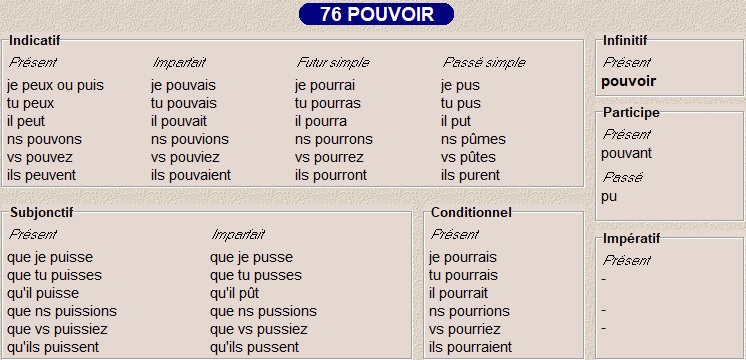
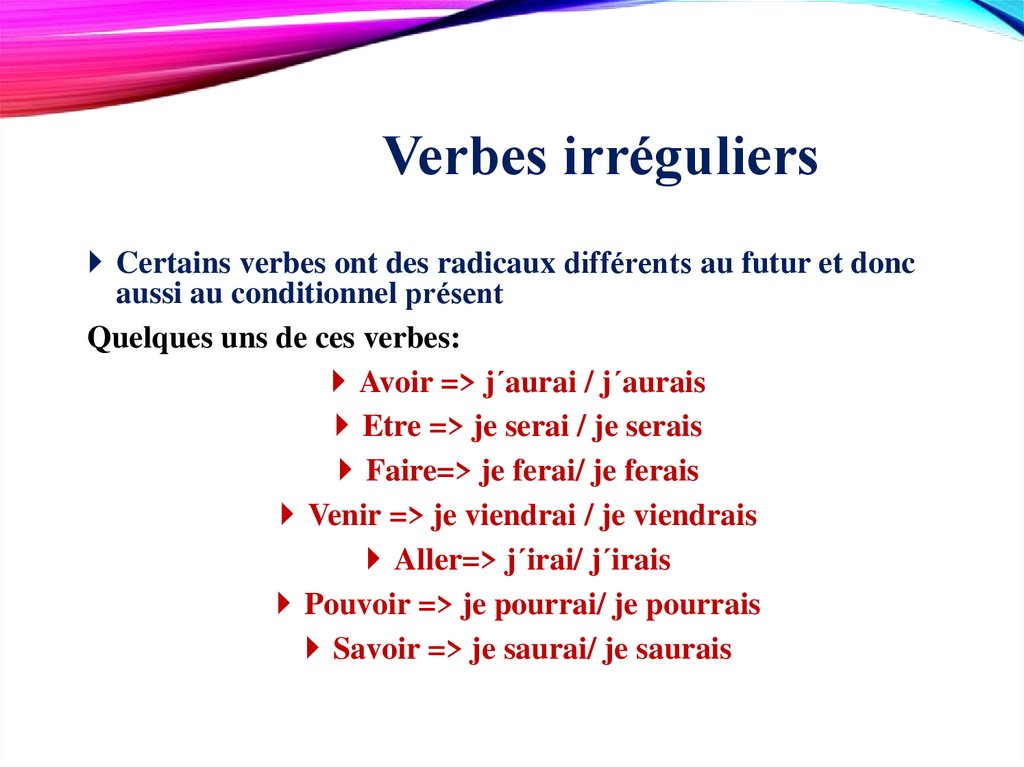
Okay, let's start with "je ne pourrai." This bad boy is the future simple tense. Future simple means we're talking about something that definitely won't happen. No ifs, ands, or buts!
Imagine this: your friend begs you to go bungee jumping. You're terrified of heights. You definitively won't be jumping off any bridges. What do you say?
"Non, non et non! Je ne pourrai jamais faire du saut à l'élastique!" (No, no, and no! I will never be able to bungee jump!)
See? Strong, definitive, and probably slightly panicked. That's the vibe of "je ne pourrai."
Consider this quirky fact: The future simple tense often sounds a little… dramatic. It's not usually used for everyday predictions, especially in spoken French. More often, you'd hear something like, "Je ne vais pas pouvoir" (I'm not going to be able to). But, knowing je ne pourrai is vital for understanding written French and sounding impressive (or melodramatic!).

Another example? "Je ne pourrai pas venir à ta fête, je suis malade." (I will not be able to come to your party, I am sick.) Unfortunate, but decisive.
Quick Recap:
- Je ne pourrai = I will not be able to
- Future Simple Tense: Firm, definitive future negative.
- Use it when there's no chance of something happening.
The Conditional is "Je Ne Pourrais"
Now, let's dive into "je ne pourrais." Ah, the conditional. The land of possibilities and polite refusals. This is where things get a little more nuanced. The conditional expresses what would happen if certain conditions were met (or not met!).
Think of it as the "I wish I could, but…" tense.
Let's go back to the bungee jumping scenario. Suppose you're still scared, but you're trying to be polite. You might consider it… maybe… if the conditions were perfect. You say:

"Je ne pourrais pas faire du saut à l'élastique, même si tu me payais!" (I wouldn't be able to bungee jump, even if you paid me!) A polite, but still firm, refusal. The "even if" adds that layer of conditionality.
It can also express a possibility. Something might happen, but it's not guaranteed. For example: “Je ne pourrais pas venir demain, car j’ai un rendez-vous.” (I wouldn’t be able to come tomorrow, because I have an appointment.) Notice how it’s less of a solid statement than "Je ne pourrai pas…". It implies that the appointment might possibly be rescheduled, even if it’s unlikely.
Here's a funny detail: The conditional is your best friend when you want to be indirect. Trying to decline a disastrous dinner invitation? "Je ne pourrais vraiment pas, j'ai déjà quelque chose de prévu." (I really couldn't, I already have something planned.) Smooth, right?
Here's another: Imagine a waiter offering you another helping of snails. Your stomach is already doing acrobatic flips. You exclaim, "Je ne pourrais plus!" (I couldn't possibly eat any more!). Politeness (and self-preservation) wins!

The conditional tense is also used to make polite requests or suggestions. For example: "Je ne pourrais pas vous aider avec ça." (I couldn't help you with that, but perhaps someone else could). A softer way to deliver bad news, isn't it?
Quick Recap:
- Je ne pourrais = I would not be able to/I couldn't.
- Conditional Tense: Expresses possibilities, polite refusals, and hypothetical situations.
- Use it when there are conditions that affect the outcome.
The Crucial Difference: Certainty vs. Possibility
The key difference is the level of certainty. "Je ne pourrai" is a definite "no." "Je ne pourrais" is a more nuanced "maybe no," often influenced by certain circumstances.
Think of it this way:
- Je ne pourrai: "The aliens will never abduct me!" (Firm belief, hopefully).
- Je ne pourrais: "I wouldn't be able to finish this entire cake by myself." (Unless I REALLY tried… and had a serious sugar craving).
A Handy Analogy: The Weather
Let’s use the weather as a parallel.
- Je ne pourrai: "Il ne pourra pas pleuvoir demain." (It will not be able to rain tomorrow - The forecast is showing sunshine for the next week). Implying a very high degree of certainty.
- Je ne pourrais: "Il ne pourrait pas pleuvoir, si le soleil continue de briller." (It couldn’t rain, if the sun continues to shine). Implying that the rain is unlikely only if the sun doesn’t give up.
Test Yourself!
Ready to put your knowledge to the test? Fill in the blank with either "je ne pourrai" or "je ne pourrais":
- _______ pas t'aider ce soir, j'ai trop de travail. (_______ not be able to help you tonight, I have too much work.)
- _______ jamais comprendre pourquoi les gens aiment le fromage qui pue! (_______ never be able to understand why people like smelly cheese!)
- Si j'avais plus de temps, _______ venir te voir. (If I had more time, _______ be able to come see you.)
(Answers below!)
Don't Overthink It!
Look, grammar can be intimidating. But the important thing is to try. Don't be afraid to make mistakes! French speakers are usually very understanding. And even if you mix up the tenses, you'll still get your point across (maybe with a little added humor!).
Focus on communication, not perfection. And remember, learning a language is a journey, not a destination. Enjoy the ride!
Answers to the Quiz:
- Je ne pourrai pas t'aider ce soir, j'ai trop de travail.
- Je ne pourrai jamais comprendre pourquoi les gens aiment le fromage qui pue!
- Si j'avais plus de temps, je pourrais venir te voir.
How did you do? Hopefully, this little explanation has helped you navigate the tricky world of "je ne pourrai" vs. "je ne pourrais." Now go forth and conjugate with confidence! Bonne chance!