Alright, alright, mes amis! Settle in, grab your café au lait, because today we're tackling a subject that can strike fear into the heart of even the most seasoned Francophile: l'impératif! Specifically, the impératif of first group verbs. But don't worry, it's not as scary as trying to explain the rules of pétanque to someone who only understands croquet. Promise!
Think of the imperative mood as the "bossy" tense. It's when you want to tell someone what to do. Imagine you're trying to teach your poodle to fetch croissants (a perfectly reasonable goal, by the way). You're not going to say, "Would you perhaps, at your leisure, consider retrieving that delightful pastry?" No! You're going to shout, "Rapporte!" (Fetch!). That, my friends, is the power of the imperative.
First Group Verbs: The Good, the Easy, and the (Slightly) Confusing
First, let's remember our amis, the first group verbs. These are the verbs that end in -er. They're the backbone of the French language, the peanut butter to its jelly, the baguette to its… well, everything. Think: parler (to speak), manger (to eat), chanter (to sing), danser (to dance) and adorer (to adore). We adore these verbs, right? Right!
These verbs are generally quite well-behaved when it comes to conjugation. Except, of course, when they're not. Which brings us to… the imperative!
Forming the Imperative: It’s Easier Than You Think (Probably)
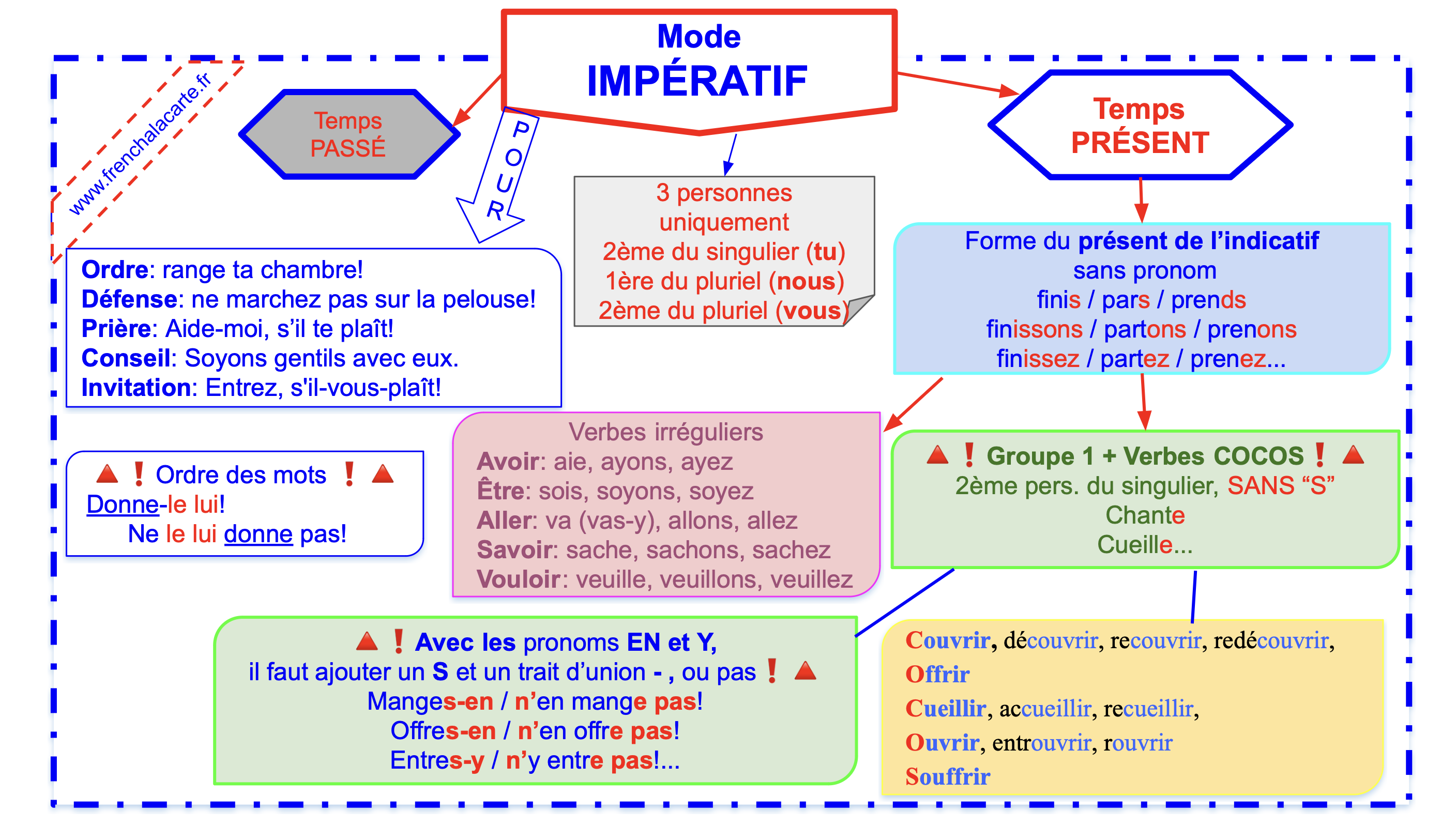
Here's the thing: with first group verbs in the imperative, you only conjugate them in three forms. That's right, three! Forget about il/elle/on, ils/elles – they’re on vacation. We're talking about:
- Tu (you - informal)
- Nous (we - let's…)
- Vous (you - formal/plural)
And here’s the really good news: You conjugate them in the present tense… almost. We’re not even dealing with the subjunctive today! (Subjunctive, consider yourself warned! We’ll be back!)
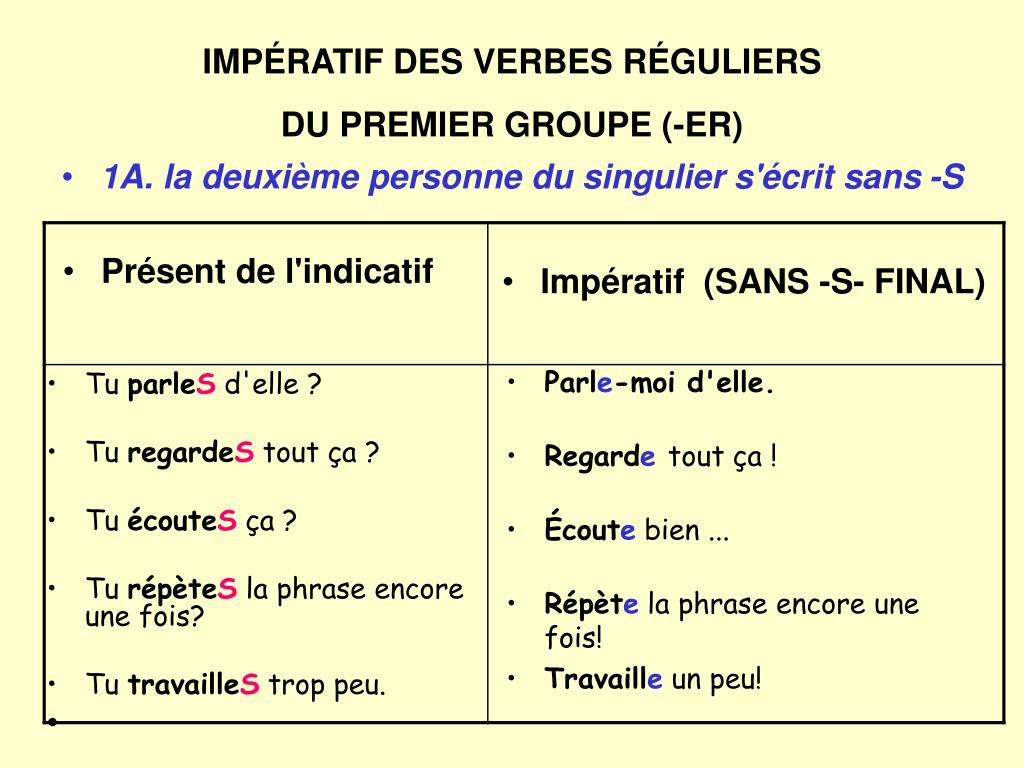
So, let's take our friendly verb, parler (to speak), as an example. In the present tense, it looks like this:
- Je parle
- Tu parles
- Il/Elle/On parle
- Nous parlons
- Vous parlez
- Ils/Elles parlent
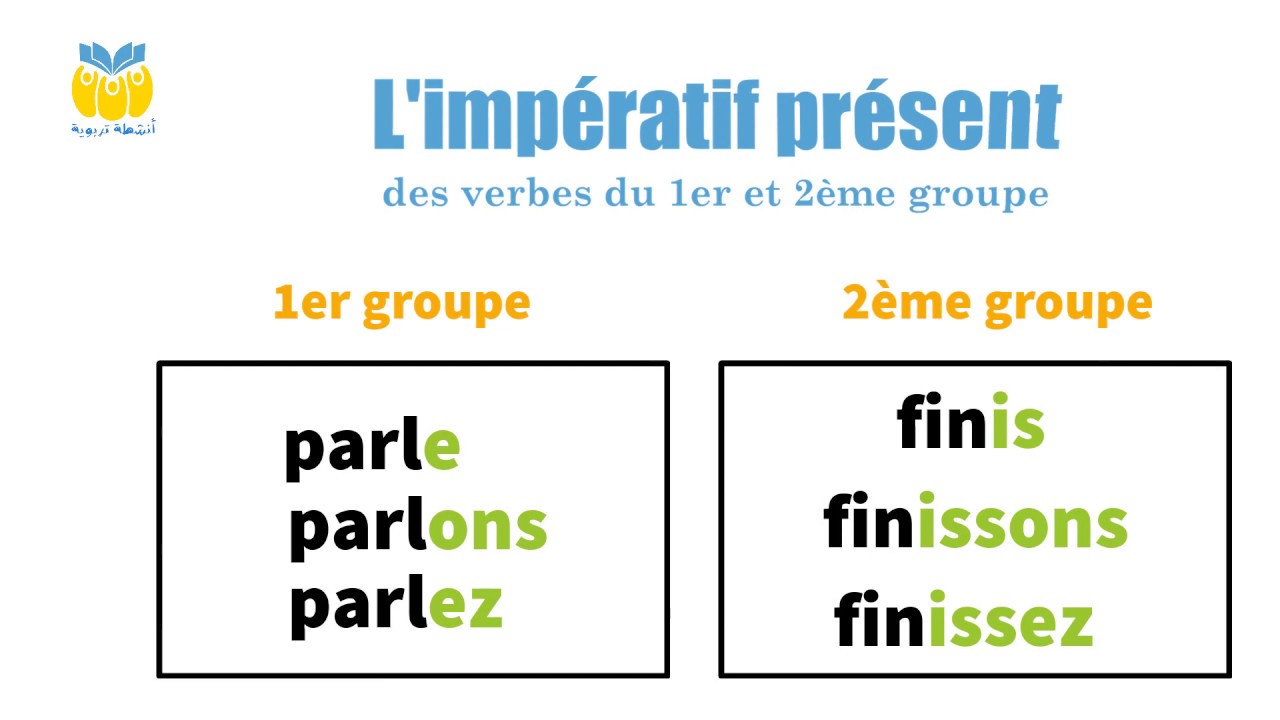
But for the imperative, we only care about tu, nous, and vous. So, we’re left with:

- Tu parles
- Nous parlons
- Vous parlez
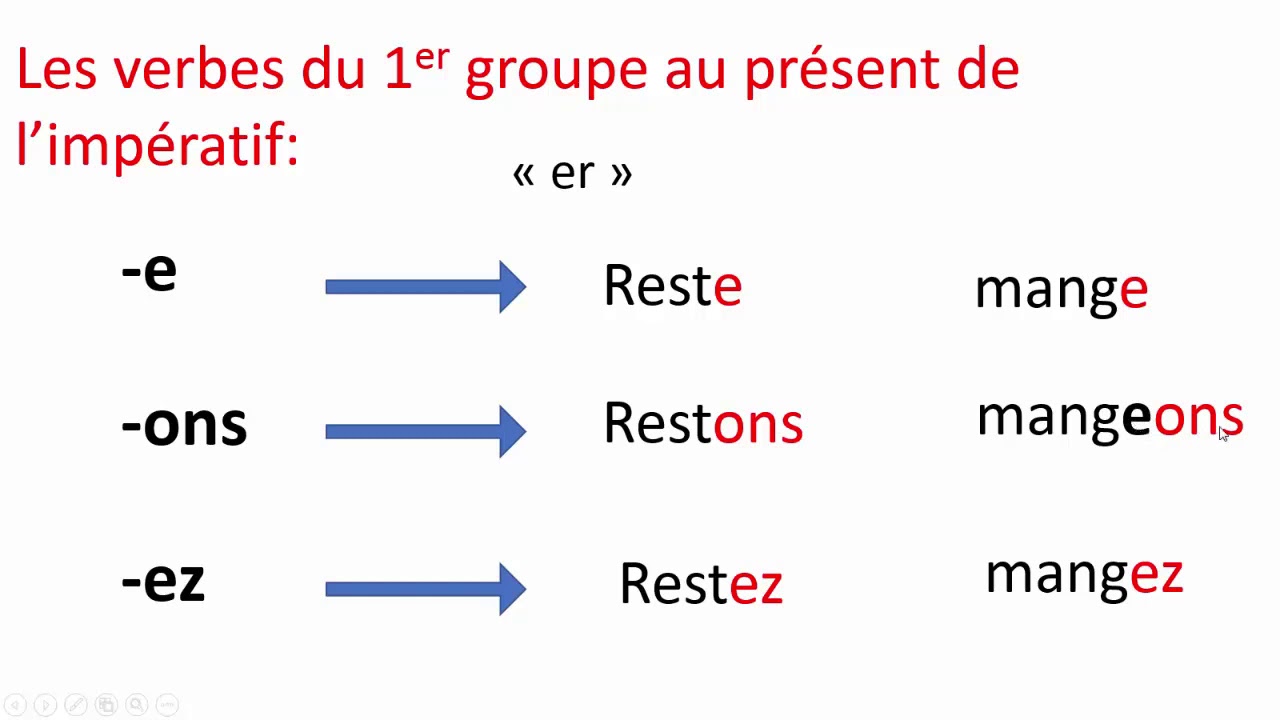
Now, here's the kicker, the pièce de résistance, the moment that separates the fluent from the… well, the less fluent. For the tu form with first group verbs (and only the tu form of first group verbs!), you drop the 's'!
Yes, you read that right. You just… get rid of it. It's like the 's' decided it wanted to go to a café and never come back.
So, parles becomes… Parle! Speak! It's like you're ordering someone to engage in conversation. Imagine you're at a mime convention. You'd shout, "Parle!" (which, ironically, would ruin the entire point of the convention).
For the other forms, just keep the present tense conjugation! So:
- Tu: Parle! (Speak!)
- Nous: Parlons! (Let's speak!)
- Vous: Parlez! (Speak! - formal/plural)
See? That wasn’t so bad. Let’s try another one: Manger (to eat).

- Tu: Mange! (Eat!)
- Nous: Mangeons! (Let's eat!)
- Vous: Mangez! (Eat! - formal/plural)
Perfect for when you're trying to encourage your friend to finally try that escargot. "Mange! It's delicious! (Probably.)"
Exceptions, Exceptions! (Because France, That's Why)
Now, before you get too comfortable, let's talk about the obligatory exceptions. Because what's French without a little bit of rule-bending? Think of it as adding a little spice to your linguistic soufflé.
Aller (to go). Ah, aller. This irregular verb thinks it's too good for the first group, but it still plays along (sort of) in the imperative. Its imperative forms are:
- Tu: Va! (Go!)
- Nous: Allons! (Let's go!)
- Vous: Allez! (Go! - formal/plural)
See? It looks like a first group verb in the nous and vous forms, but the tu form, "va," is totally rogue. Just remember it. Embrace the weirdness.
Verbs ending in -ger. Ah, these verbs... they're always causing trouble. Remember manger from before? Well, when we use "nous mangeons" in the imperative, we keep the "e" after the "g" in the nous form. Why? Because without it, it would sound like "man-gohns," which sounds less like "Let's eat!" and more like a strangled goose. We want to avoid strangled goose impressions at all costs. Therefore:

- Mangeons! (Let's eat!)
Without that “e”, the ‘g’ would make a hard ‘guh’ sound, not the soft ‘zhuh’ sound we want.
The Impératif with Pronouns: Adding a Little ZING!
Want to take your imperative game to the next level? Add pronouns! But, just like with everything else in French, there are rules. And surprises!
When using pronouns with the imperative, you attach them to the end of the verb with a hyphen. For example:
- Parle-moi! (Speak to me!)
- Donne-le-moi! (Give it to me!)
Notice how the "me" and "le" become "moi" and "-le" and attach with a hyphen. The same happens with toi, but only in the imperative. Like a small, exclusive party for pronouns being extra.
Also! And this is important: when you add -moi to a first group verb that dropped its 's' in the tu form, you put the 's' back!
So, Parle becomes Parles-moi! That’s right, the "s" is back, baby! It finally returned from its café vacation, probably with a croissant stain on its beret. The croissant must have said "Parles-moi!"
Why? Because French is a language that loves to keep us on our toes. Embrace the chaos. Love the madness.
Practice Makes Parfait (Or, At Least, Pretty Good)
So, there you have it! The imperative of first group verbs, demystified (hopefully). Now, go forth and boss people around! (Politely, of course. Remember to say "s'il vous plaît").
Here are a few to practice with, just to make sure you've got it:
- Écouter (to listen)
- Regarder (to watch)
- Aimer (to like/love)
- Voyager (to travel)
So, get out there and Parle français! Mangez bien! Voyagez souvent! And most importantly, Amusez-vous! (Have fun!) Because if you're not having fun while learning French, you're doing it wrong. Au revoir, mes amis! And don’t forget to Révisez!