
Okay, imagine this: I'm at a ridiculously overpriced coffee shop (because, you know, math needs caffeine), and I’m staring at the prices. A small latte is, like, five bucks. A large? Seven! Suddenly, I had a burning question: how much more coffee am I really getting for those extra two dollars? Is it worth it? This, my friends, is where the concept of slope, or coefficient directeur as our French-speaking friends call it, swoops in to save the day... or at least help you avoid being ripped off on latte sizes. (Spoiler alert: probably not worth it.)
So, what is this mysterious "coefficient directeur," and why should you, someone who probably just wants to know how to bake the perfect pain au chocolat, care?
Le Coefficient Directeur: L'Essentiel
Simply put, the coefficient directeur (often abbreviated as "m" in equations like y = mx + b) measures the steepness of a line. It tells you how much the y-value changes for every unit increase in the x-value. Think of it as the "rise over run." It's a ratio, a comparison of vertical change to horizontal change.
Think of a ski slope! A steeper slope has a higher coefficient directeur (you'd be going faster, right?). A gentle slope? A much smaller coefficient. A flat road? Coefficient directeur of zero! You get the picture. (And you do get the picture, don't you? Because I’m trying really hard here.)
How to Calculate it: The Formula You Need to Know
Alright, ready to put on our math hats? (They're quite stylish, I assure you.) The formula for calculating the coefficient directeur is remarkably simple:
m = (y2 - y1) / (x2 - x1)
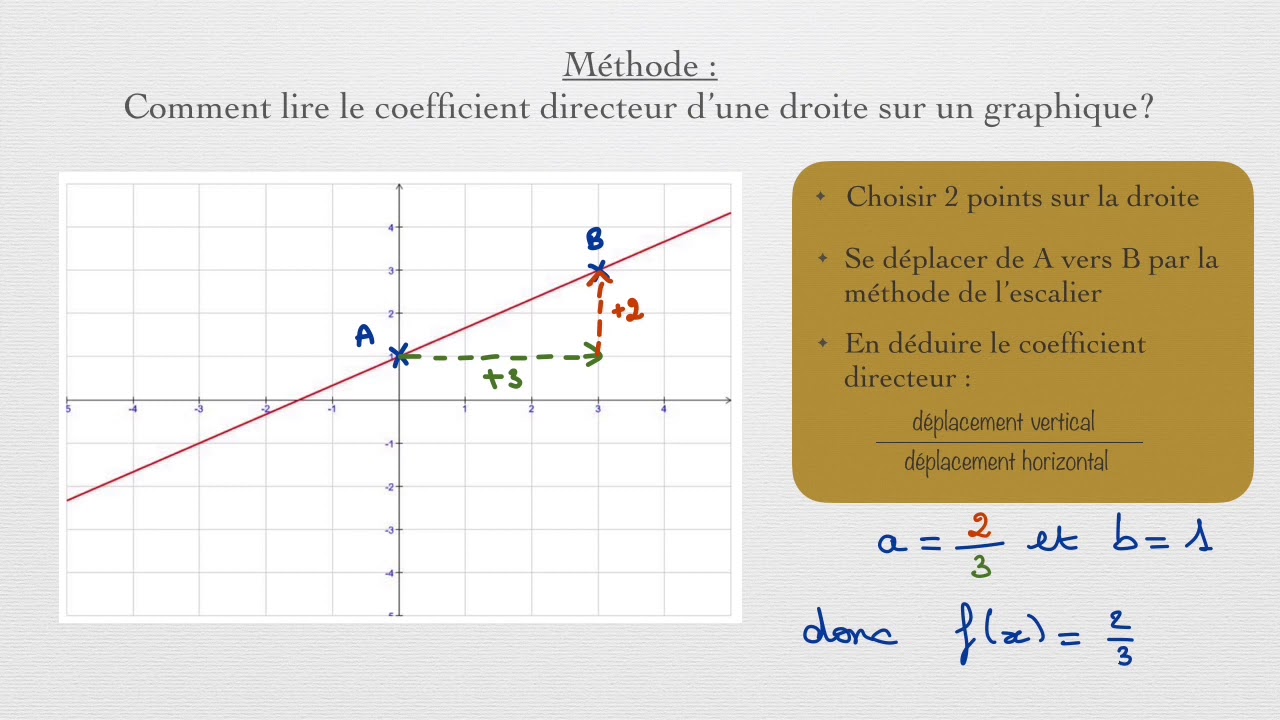
Where:
- (x1, y1) are the coordinates of one point on the line.
- (x2, y2) are the coordinates of another point on the line.
That's it! Easy peasy lemon squeezy, as they say. (Except, you know, in French. "Facile comme bonjour" maybe? I’m workshopping it.)
Let’s break it down with an example:

Suppose we have two points on a line: (2, 3) and (5, 9). Let's plug those values into our formula:
m = (9 - 3) / (5 - 2) = 6 / 3 = 2
So, the coefficient directeur of this line is 2. This means that for every one unit we move to the right (increase x by 1), we move up two units (increase y by 2).

Understanding Positive, Negative, and Zero Slopes
The sign of the coefficient directeur tells you a lot about the line:
- Positive Coefficient Directeur (m > 0): The line slopes upwards from left to right. Like climbing a hill. Think of it like an investment that’s actually making money!
- Negative Coefficient Directeur (m < 0): The line slopes downwards from left to right. Like skiing downhill (or, you know, an investment going south).
- Zero Coefficient Directeur (m = 0): The line is horizontal. It's a flat line, parallel to the x-axis. No uphill, no downhill, just cruising.
- Undefined Coefficient Directeur: This occurs when the denominator (x2 - x1) is zero. This means the line is vertical. Good luck skiing that slope! (Or investing in that stock!)
Important side note: The order of the points doesn't actually matter, as long as you're consistent. Meaning, if you do (y2 - y1) in the numerator, you must do (x2 - x1) in the denominator. Flipping the order in just one of them will give you the negative of the correct slope. Still useful, just...negative. Don’t be negative!
Putting it All Together: Real-World Applications (Beyond Coffee!)
Okay, I know what you’re thinking: "This is great, but when am I ever going to use this outside of a math class?" The answer? More often than you think!

- Construction and Architecture: Calculating the slope of a roof, a ramp, or a staircase. You wouldn’t want a staircase that’s impossible to climb, would you?
- Economics: Analyzing the rate of change of prices, supply, or demand. (Remember my coffee example? See, I told you it was relevant!)
- Physics: Determining the velocity of an object (the slope of a distance-time graph). Vroom vroom!
- Data Analysis: Identifying trends in data sets. Is your company’s revenue going up or down? The slope will tell you!
- Navigation: Calculating the angle of ascent or descent. Useful if you’re, say, a pilot. (Please know this if you're a pilot!)
The coefficient directeur is a fundamental concept in mathematics and has wide-ranging applications across various fields. It's a tool for understanding and analyzing rates of change, trends, and relationships between variables. So, yeah, knowing this stuff is actually pretty useful.
A Few Extra Tips and Tricks
- Visualizing the Slope: Always try to visualize the line when you're calculating the slope. Draw a quick sketch, even if it's just a rough one. This will help you catch any errors, especially with the sign of the slope.
- Simplifying Fractions: Always simplify your slope to its lowest terms. A slope of 4/2 is the same as a slope of 2, but the latter is much easier to work with.
- Slope-Intercept Form: Remember the equation of a line in slope-intercept form: y = mx + b. "m" is the slope, and "b" is the y-intercept (where the line crosses the y-axis). Knowing this can make it super easy to find the slope if you're given the equation of the line.
Conclusion: Embrace the Slope!
So there you have it! The coefficient directeur demystified. It's not just some abstract mathematical concept; it's a powerful tool for understanding and analyzing the world around us. From calculating the steepness of a ski slope to predicting economic trends, the slope is everywhere.
Next time you're faced with a line (literal or figurative!), remember the formula, visualize the slope, and embrace the power of the coefficient directeur. And maybe, just maybe, you’ll finally figure out if that large latte is really worth the extra two bucks.
Now, if you'll excuse me, I'm going to go find a cheaper coffee shop. This math stuff is making me thirsty... and broke. (Maybe I should calculate the slope of my bank account balance...ouch!)
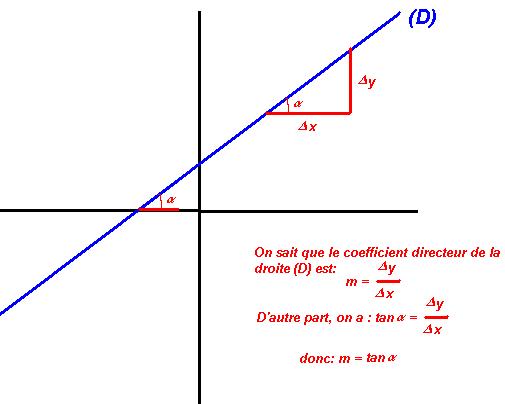


![Calcul du coefficient directeur [Équations de droites]](https://lecluseo.scenari-community.org/2DE/Equations_de_droites/res/interpcd.png)


