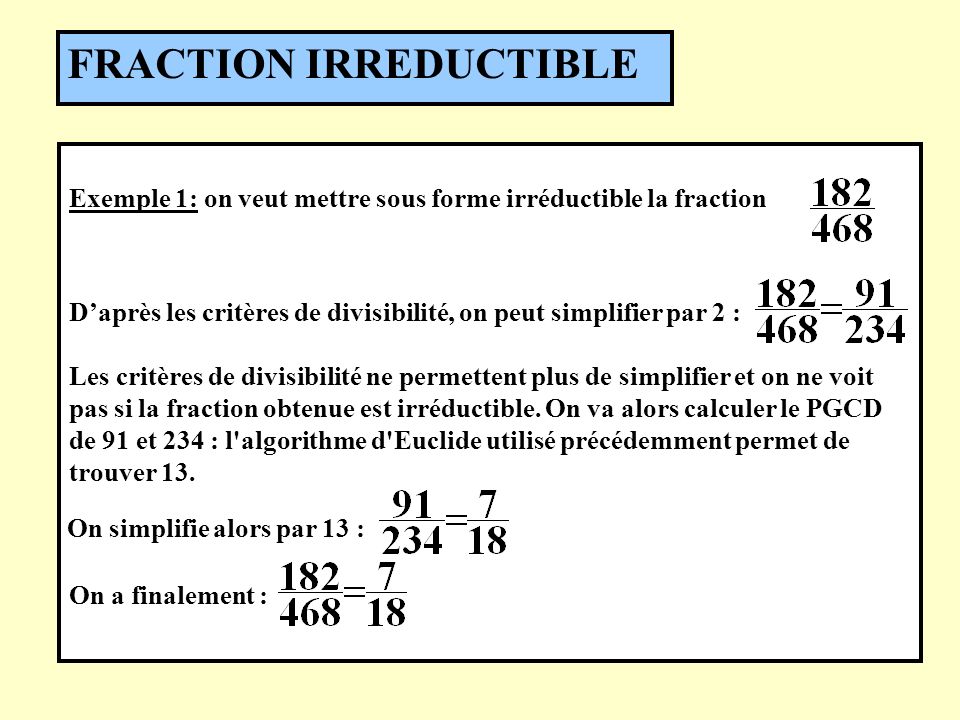
Okay, imagine this. I’m at the boulangerie, right? Trying to order, like, one croissant aux amandes (because self-control is a myth, let's be real). And the baker, a delightful woman named Madame Dubois, is juggling about five different orders at once. Suddenly, she stops, stares intensely at a handwritten recipe, mutters something about "simplification maximale," and then smiles triumphantly. Apparently, she was trying to halve a fraction for her new batch of pain au chocolat (damn her delicious efficiency!). That's when it hit me: fractions are everywhere, and sometimes, they're screaming at us to be simplified. But how do we know when we've gone as far as we can go? How do we know when a fraction is truly, irrevocably, irréductible?
Let's dive in! Because irreducible fractions are kind of a big deal. They're the fractions that have reached their ultimate, streamlined form. The fraction equivalent of a Marie Kondo-ed sock drawer. (Except hopefully less... folding.)
What Exactly is an Irreducible Fraction?
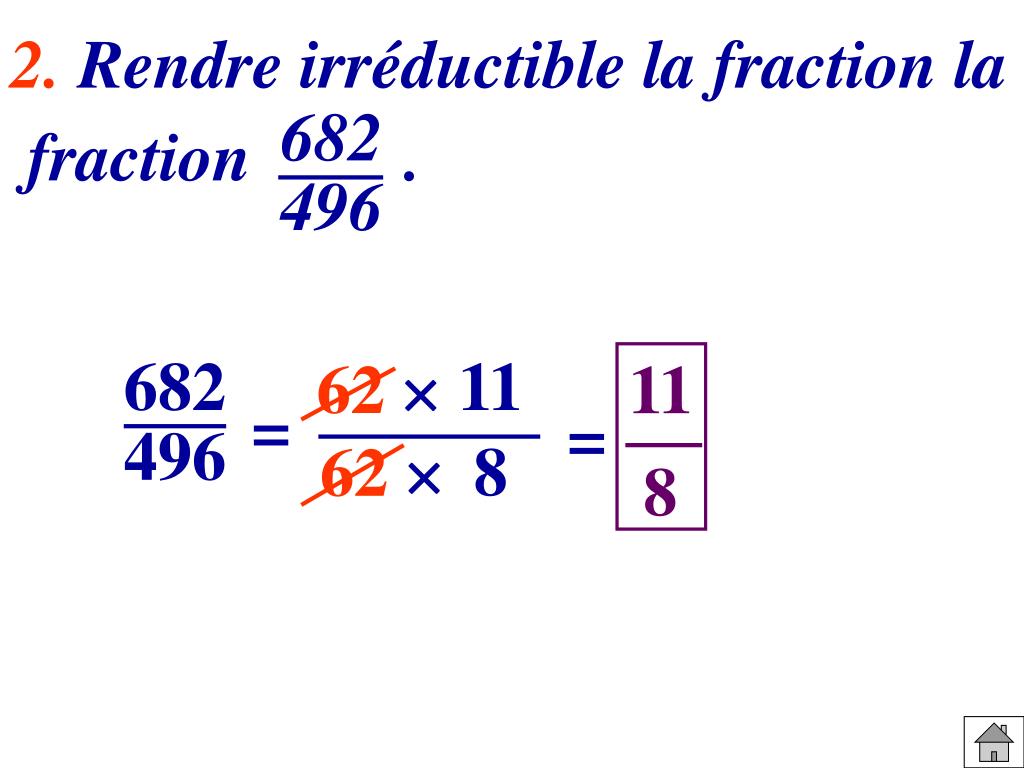
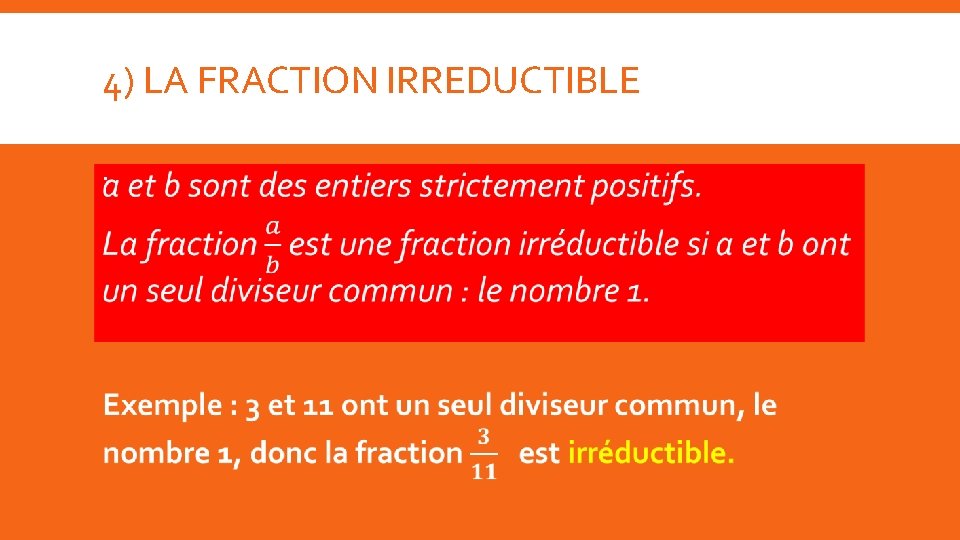
Alright, let's break it down. An irreducible fraction is a fraction where the numerator (the top number) and the denominator (the bottom number) have no common factors other than 1. Think of it like this: they're prime-number besties in disguise. You can't divide them both by the same number (other than 1, obviously) to get a smaller whole number.
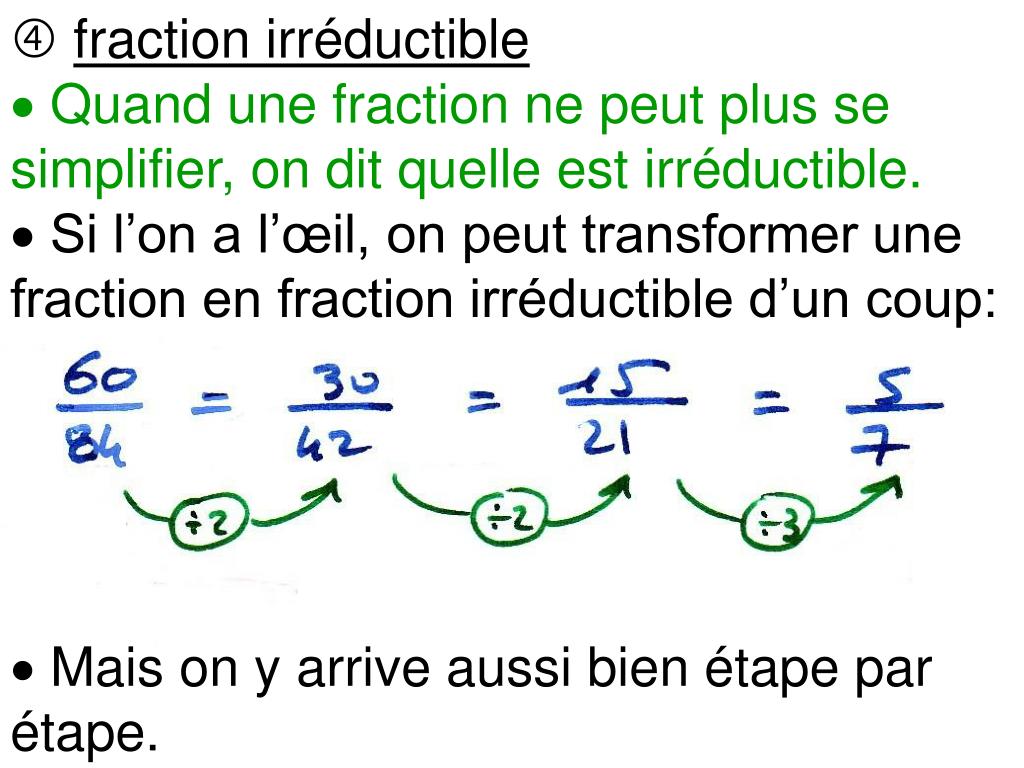
For example, 3/5 is irreducible. 3 and 5 only share one factor: 1. But 4/6 is NOT irreducible. Why? Because both 4 and 6 can be divided by 2. Meaning we can simplify it to 2/3. And 2/3 is irreducible. Get the picture? (Hope so, because there will be a quiz later... kidding! Mostly.)
The GCD: Your Secret Weapon
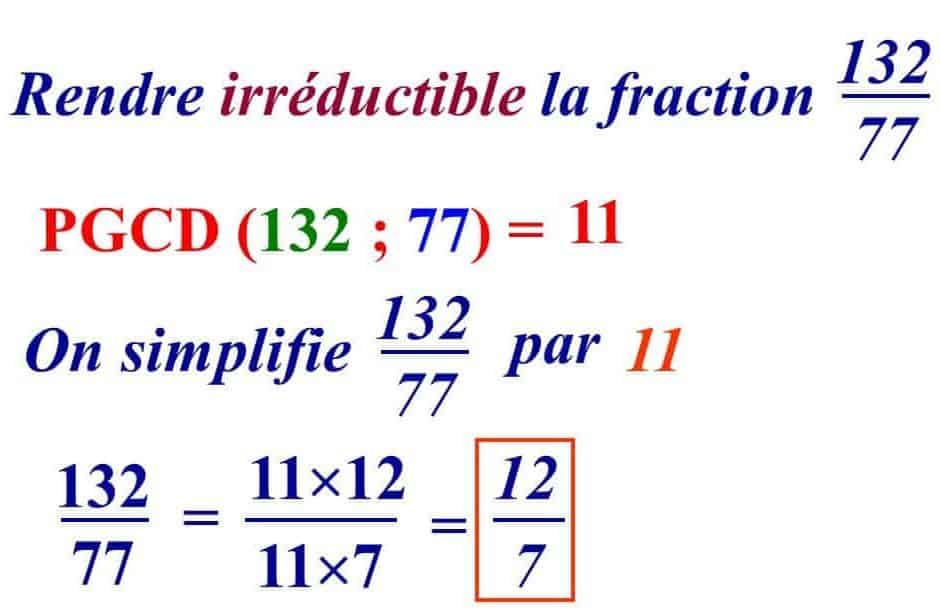
So, how do we actually find out if a fraction is irreducible? Enter the GCD – the Greatest Common Divisor! This is the largest number that divides evenly into both the numerator and the denominator. If the GCD of the numerator and denominator is 1, then BAM! You've got yourself an irreducible fraction.
Think of the GCD as the key to unlocking the secret of irreducibility. Find the key, unlock the fraction, and see if there's any simplifying magic left to do.
How to Calculate the GCD
Okay, so finding the GCD isn’t always a walk in the park, especially with larger numbers. But fear not! We have a few methods at our disposal:

- Listing the Factors: This works well for smaller numbers. Just list all the factors of both the numerator and the denominator, and then find the biggest one they have in common.
For example, let's look at 12/18:
- Factors of 12: 1, 2, 3, 4, 6, 12
- Factors of 18: 1, 2, 3, 6, 9, 18
The greatest common factor is 6. Since the GCD is 6 (and not 1), 12/18 is not irreducible.
(See? Not too scary. Although, I wouldn't recommend this method for, say, 456/789. Unless you're really bored.)
- Prime Factorization: Break down both numbers into their prime factors. Then, identify the prime factors they share, and multiply them together.
Let's revisit 12/18:

Vidéo 6 : Rendre une fraction irréductible - YouTube - Prime factorization of 12: 2 x 2 x 3
- Prime factorization of 18: 2 x 3 x 3
They share a 2 and a 3. So, the GCD is 2 x 3 = 6. Again, not irreducible!
- Euclid's Algorithm: This is the big gun of GCD calculation. It's a systematic process that involves repeated division and finding remainders. It sounds complex, but it's actually quite elegant.
Here's how it works:
- Divide the larger number by the smaller number.
- If the remainder is 0, the smaller number is the GCD.
- If the remainder is not 0, replace the larger number with the smaller number, and the smaller number with the remainder.
- Repeat the process until the remainder is 0.
Let's try it with 48 and 18:
- 48 ÷ 18 = 2 with a remainder of 12
- 18 ÷ 12 = 1 with a remainder of 6
- 12 ÷ 6 = 2 with a remainder of 0
The last non-zero remainder was 6, so the GCD of 48 and 18 is 6. (And, you guessed it, 48/18 is reducible.)

Les fractions irréductibles - YouTube (Okay, maybe "elegant" is a strong word. But it is effective. Trust me.)
Irreducible Fractions in the Real World
Now, you might be thinking, "Okay, this is all very interesting, but why should I care about irreducible fractions outside of a math textbook?" Valid question! The truth is, irreducible fractions pop up in all sorts of places:
- Computer Science: When simplifying ratios in graphics and image processing.
- Cooking: Like Madame Dubois and her pain au chocolat! When scaling recipes up or down, simplifying fractions helps ensure accuracy.
- Probability: Expressing probabilities in their simplest form makes them easier to understand and compare.
- Everyday Life: Splitting a pizza evenly? Calculating discounts? You're probably dealing with fractions, and simplifying them (making them irreducible!) makes the math a whole lot easier.
Quick Tips and Tricks
Alright, here are a few quick ways to spot irreducible fractions (or at least get a good head start):
- If the numerator is 1, the fraction is always irreducible. (1/2, 1/7, 1/1000 – all irreducible!)
- If the numerator and denominator are both prime numbers, the fraction is always irreducible. (3/7, 5/11, 13/17 – you get the idea.)
- If the numerator and denominator are consecutive numbers, the fraction is always irreducible. (2/3, 7/8, 20/21 – easy peasy!)
- Check for divisibility by small prime numbers (2, 3, 5, 7). If both numbers are divisible by any of these, the fraction is definitely not irreducible.
(Okay, those are more like shortcuts than tricks, but hey, who's counting?)

Practice Makes Perfect! (But Don't Stress)
The best way to get comfortable with irreducible fractions is to practice! Grab a textbook, find some online exercises, or even just make up your own fractions and see if you can simplify them. The more you practice, the faster you'll become at spotting those irreducible little gems.
But remember, it's okay to make mistakes! We all do. The important thing is to keep learning and keep exploring the wonderful world of fractions. (Yes, I said "wonderful." Don't judge me.)
So, next time you're faced with a fraction, take a deep breath, remember Madame Dubois, and ask yourself: "Is this fraction truly irréductible?" And if it's not, get simplifying! You've got this!
Now, if you'll excuse me, I think I deserve that croissant aux amandes after all this math talk. À bientôt!